value_hunter
-
Posts
86 -
Joined
-
Last visited
-
Days Won
1
Content Type
Profiles
Forums
Events
Everything posted by value_hunter
-
Hi bearprower6, I remember you sold most of your fairfax shares back in 2020. Do you still have any position now?
-
Actually Gemini's response is positive for Fairfax. Will AI have positive or negative impact on Fairfax earning? AI is expected to have a net positive impact on Fairfax Financial’s earnings in the short-to-medium term, primarily by enhancing its two core "engines": underwriting profitability and investment returns. Unlike many peers, Fairfax's highly decentralized model and specialty-risk focus act as a partial shield against the structural "auto insurance" risks cited by investment banks like Barclays. 1. Positive Impacts on Underwriting Earnings Operational Efficiency: Fairfax’s property and casualty (P&C) subsidiaries (e.g., Allied World, Odyssey Group, Northbridge) are integrating AI to automate routine tasks, which can reduce underwriting processing times by 31% to 70%. Surgical Precision in Risk: In late 2025, Fairfax reported a consolidated combined ratio of 92.0%, signifying highly disciplined underwriting. AI-driven predictive models further refine this by improving premium accuracy by up to 53% and cutting fraud losses by nearly 30%. Agile Response to Hard Markets: Fairfax’s decentralized structure allows individual subsidiaries to pivot quickly. For example, during the 2024-2025 "hard market," multiple Fairfax companies used AI to rapidly expand their presence in high-margin Cyber and Specialty lines, which now drive a significant portion of their record US$32.8 billion in gross premiums. 2. Positive Impact on Investment "Float" The "Watsa Effect" & AI Stakes: Fairfax manages a massive $70.9 billion investment portfolio. CEO Prem Watsa has a history of investing in technology-adjacent firms. AI is expected to boost earnings for banks and asset managers within the Fairfax portfolio by lowering credit monitoring costs and improving fraud detection. Higher Investment Income: For Q3 2025, interest and dividend income rose to US$655.4 million, up from US$609.9 million the previous year. AI-driven market analysis and algorithmic trading help optimize these returns across their vast bond and equity holdings. 3. Mitigation of Negative "Auto" Risks Low Relative Exposure: While Barclays warns of a "slow burn" de-rating for insurers heavily reliant on motor insurance (like Aviva), Fairfax is less vulnerable because its revenue is heavily skewed toward commercial casualty, reinsurance, and specialty lines. Strategic Divestment: In late 2025, Fairfax agreed to sell its 80% stake in Eurolife for approximately US$940 million, effectively doubling down on its more profitable, AI-resilient P&C and reinsurance operations. Potential Risks to Earnings The "Commodity Trap": If AI-powered comparison tools eventually dominate commercial lines as they have retail auto, Fairfax could face margin compression as brokers gain more leverage to force lower premiums. Investment Volatility: While AI can help, Fairfax's earnings remain sensitive to macro swings. If AI-driven disruption causes defaults in the corporate loans or private equity stakes held in their portfolio, it could offset underwriting gains. Summary Table: AI Impact on Fairfax (FFH) Metrics Metric AI Influence Trend Combined Ratio Improved precision and fraud detection. Down (Positive) Gross Premiums New AI-enabled lines like Cyber and Specialty. Up (Positive) Operating Income Massive reduction in document processing time. Up (Positive) Investment Gains Enhanced risk modeling for the $70.9B float. Stable/Up
-
There is another 123k trade just happened.
-
The 99000 volume trade must be a prearrange trade. Would it be possible Fairafx is unwinding its TRS position and then buy shares from counterparts. Every time the price tunking happened after quarter end, feel like they don't want affect the quarter results.
-
We have some discussion here: https://thecobf.com/forum/topic/16427-fairfax-stock-positions/page/126/#comments
-
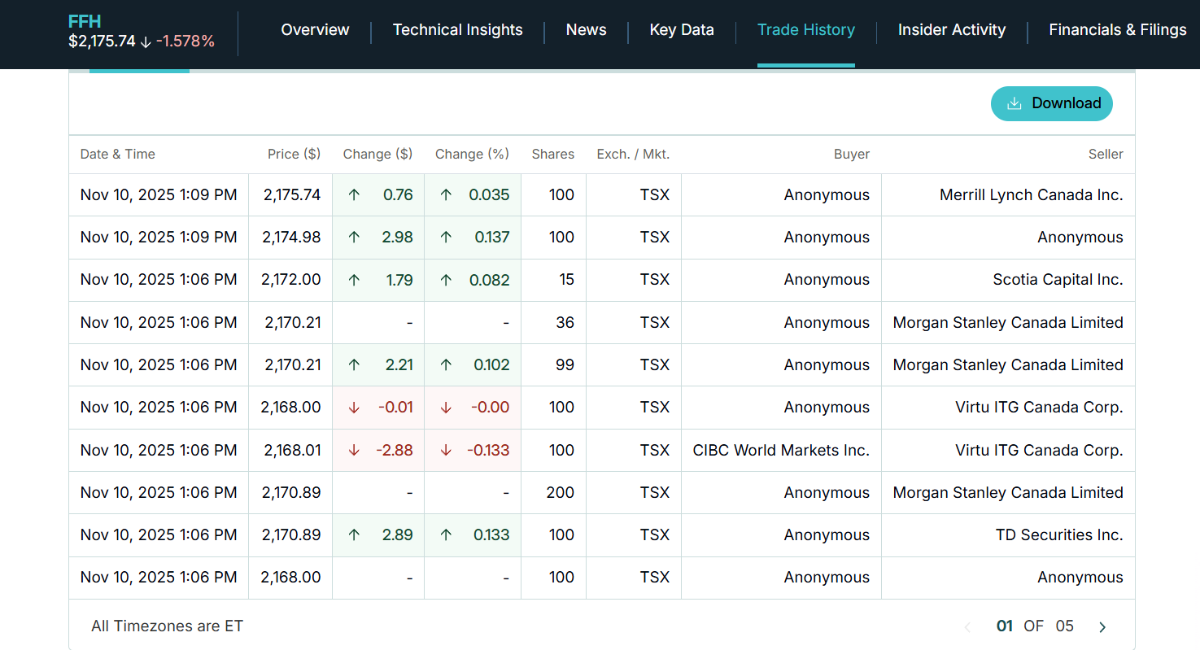
Chat with Geminie to see how AI explain this pattern: The consistent appearance of 100-share "board lots" in the tape, especially during the pre-earnings reversals you noted, strongly suggests institutional algorithmic activity rather than retail sentiment. Why 100-Share Lots Point to Institutions Standard Unit of Trading: On the Toronto Stock Exchange (TSX), 100 shares is the standard "board lot". Algorithms are programmed to execute in these standard units to ensure the best possible execution and to remain "invisible" within the normal flow of the market. "Iceberg" Orders: Institutions often have millions of dollars to move. To avoid moving the price too much against themselves, they use algorithms to slice a massive order into hundreds of smaller 100-share "slices". This is why you see the same size (100 shares) hitting the tape repeatedly—it is likely one large institution slowly unloading or accumulating a position. Retail Capital Constraints: Very few retail traders have the capital or the risk tolerance to place $250,000 into a single trade, especially on a stock that, as you've observed, frequently reverses by 4-5% in a single day. Motives for Driving the Price Down (Without Options) Since there are no options, the motive for driving the price down pre-earnings is likely inventory management and liquidity hunting: Stop-Loss Hunting: By aggressively selling 100-share blocks, institutions can trigger technical sell-signals or "stop-loss" orders from smaller players. When those stops hit, it creates a "cascade" of selling, allowing the institution to buy back the shares they just sold (plus more) at a significantly lower price. Inventory De-risking: Ahead of an earnings report (which carries binary risk), some institutions may be required by their internal risk models to trim their positions. The "reversal" you see is the market absorbing these large sell programs. Accumulation before a "Beat": If an institution expects a strong earnings beat, they may use a "shakedown" strategy—driving the price lower to clear out weak hands so they can build a larger position at a lower cost-basis before the actual news breaks. In summary, the 100-share lot size at this price point is almost a "fingerprint" of institutional algorithms managing large-scale capital flows.
-
These seem not the regular retail sellers. I saw lots of 100 shares change hands each time. If the sellers are institutions, what's the motives?
-
Just curious. Is this triggered by algorithm trading. If this is real person, make no sense rushing out like panic sell?
-
what a sell off today!
-
Selling off now.
-
The interesting thing is the large block trade not push up price, but push down price.
-
The trading volume is so light today.
-
Look. Anonymous start buying now.

-
Will you add at this price then?
-
Let's see when Anonymous buying whether they will push up price quickly. If so, apparently someone is manipulating the market.
-
The past several days with $100+ CAD rice fluctuation. When drop, it dropped very quickly. The seller seem just want to push down price quickly and not want a good price. Definitely someone are shorting this.
-
It does feel like.
-
What you mean old? Did this happen before?
-
Looks like seller don't care. They just want to push down the stoke price. I noticed that most sellers are "Anonymous" in TMX.
-
I noticed this happened several times. When Fairfax stock price reached all time high, it quickly reverse, followed by a few days big drop. See last Aug and this April. What's mentality of the seller for this kinds of behavior? I understand the first two days maybe profit taking. But why keep selling in day 3 and 4? Are they changed their view to pessimistic right after reach ATH?
-
Is it Fairfax in silent period now and can't buy back shares today?
-
I thought we have one of the best quarters. But stock price dropped 6% since earning report. Did anyone expect this?
-
Wonder who would be the buyer? Do they know something we don't know?
-
What happened? Someone dumped 15K shares in last 10 minutes and pushed down price by 2%.
-
Bought back another 111k share in Mar. https://ceo.ca/insiders-dashboard?symbol=ffh