DocSnowball
-
Posts
398 -
Joined
-
Last visited
Content Type
Profiles
Forums
Events
Everything posted by DocSnowball
-
This is what I could find online - a mutation in the spike protein, along with 12 human cases. Don't have competence in this area to give a good answer, but on the surface of it, this is similar to what is done to prevent emerging avian flu outbreaks when a new strain is detected that transmits to humans from animals. https://www.reuters.com/article/us-health-coronavirus-denmark-mink/denmark-tightens-lockdown-in-north-mink-cull-devastates-industry-idUSKBN27L2JT It always made me nervous that we never got to find out the animal reservoir, if any, in China from where the virus could have jumped into humans. There wasn't much info offered about any analysis from Wuhan Seafood market or other areas in China. One can only assume that animal reservoir hasn't been the source of more animal-to-human transmission given the low numbers in China, but who knows.
-
FNMA and FMCC preferreds. In search of the elusive 10 bagger.
DocSnowball replied to twacowfca's topic in General Discussion
Toomey might well be in the "let it happen" column. Question is, who (person) or what (catalyst) would "make it happen" still? I think if nothing happens prior to transition of power, then looks like it may be a long drawn out wait once again, subject to the court ruling. The court hearing and if progressing then its result are the two sure events on the calendar, everything else seems to be subject to the kindness of strangers. -
Coronavirus - the living with the virus / recovery angle
DocSnowball replied to Viking's topic in General Discussion
Great thread and question. I'm starting to look at companies which have low debt and can come out with a changed narrative in terms of their total addressable market on the other side. I think Disney is on its way to doing this but wish it had less debt. I think the most pent up demand is in being able to socialize again - how depends, can be individual interactions in nature, small gatherings, entertainment like movies and store shopping, community events, public events in order of increasing risk. One thing that has changed in medicine in Telemedicine. Here to stay for sure. While I'm not that thrilled about standalone telemedicine companies, what may emerge is a "platform" company for healthcare to get your tele visits done, order your meds and have them delivered to your home - by your own doctor not someone you barely know. Still looking for how this shakes out but patients have tasted convenience and want more of it. Faster trials and FDA approvals are also noticeable and could impact Pharma lifecycle times and success rates. One thing that has changed in education is asynchronous learning in mainstream institutions. We are now building a decent proportion of events online and asynchronously because it's insanity to expect people will keep sitting to learn for hours and hours (try Elucidat if you haven't, would have loved to invest in it). This, and the virtual learning platforms like Zoom rooms are here to stay. I think in the coming years people will invest in recreating and changing careers more going forward - perhaps a lot more of getting into a job or apprenticeship and patching together applicable credit courses to get a "degree" or "certification". Platforms that provide this will seriously challenge the bloated academic institutions. Lots more to think about! -
Europe got complacent. Cases here are rising too - in all regions. I think we will crack 100k cases/ day very quickly. Hospitalization is the one metric to look at. The last waves topped out at 60k COVID-19 hospitalization. Once we get to this number, the hospitals system becomes strained, we are going to have local restrictions again. Edit: another indicator - my wife went to Costco today and noticed that several items like paper, wipes were sold out, just like during the first wave. Apparently people are getting ready for things to come. Hording confirmed from my wife‘s sources in the Bay Area ( Asian people tend to be early). Long lines in grocery stores & Costco, some paper goods and Ramen noodles sold out etc. We have seen this before.... So, it wasn’t just me. Animal instincts are much earlier on display in a Walmart than in Wegman‘s: https://finance.yahoo.com/news/walmart-ceo-consumers-are-stocking-up-again-as-coronavirus-rages-on-174308762.html Connecticut recorded 2047 cases on October 25th. The only other day more cases (2109) were recorded in our state during the pandemic was April 22nd. While those numbers were a gross underrepresentation back then, we are no doubt seeing a very significant and sustained uptick now.
-
Well at least you admit it. This was not a low stakes issue which is why I questioned your level of confidence. When people become confident in such things, the danger is that precaution is thrown aside. When leaders dismiss precaution and instead exhibit confidence that “the virus will be gone soon” or “a vaccine will be here soon”, the cost of them being wrong—economically and in terms of lives lost—is massive and will be borne by society... The Asian countries and some others like NZ seem to get the precautionary principle. Others not so much. Let's for a moment assume the herd immunity thesis is broken (we don't know that yet). You're not the only one holding it, there are plenty of others who will realize this as cases and hospitalizations go up, and we anticipate they could go up fast. My question is, can one make money from this understanding? If yes, where are the opportunities to make money if a significant third wave hits? Edit: this question is based on the realization that cases and markets have not correlated much in the last 6 months
-
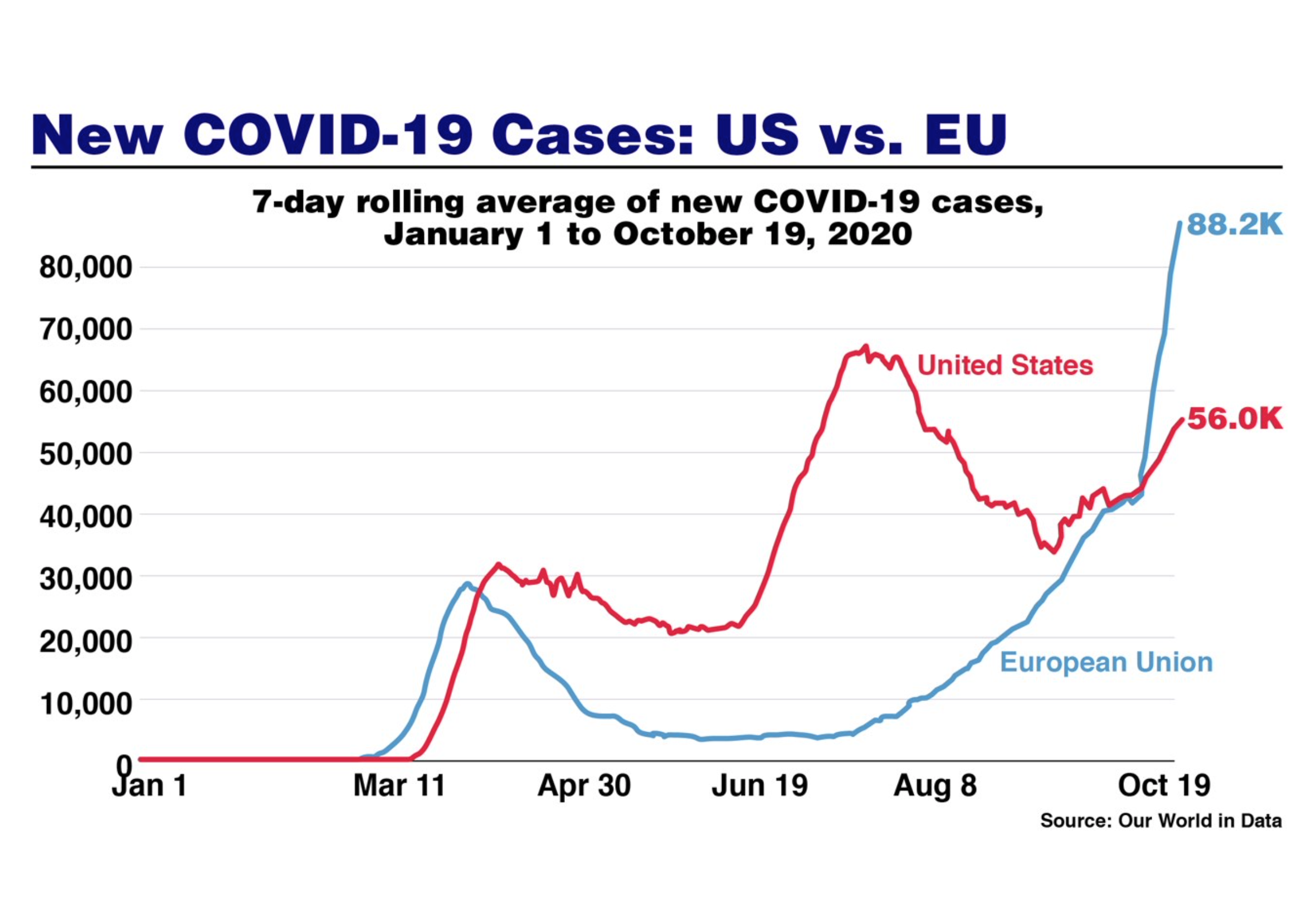
Europe got complacent. Cases here are rising too - in all regions. I think we will crack 100k cases/ day very quickly. Hospitalization is the one metric to look at. The last waves topped out at 60k COVID-19 hospitalization. Once we get to this number, the hospitals system becomes strained, we are going to have local restrictions again. Edit: another indicator - my wife went to Costco today and noticed that several items like paper, wipes were sold out, just like during the first wave. Apparently people are getting ready for things to come. Interesting - I had the same feeling and behavior at Costco yesterday, and ended up wondering if it was just me feeling that way or a lot of others. Purely anecdotal and likely biased. Anthony Fauci spoke at the annual ID society meeting yesterday and shared this graph comparing US and Europe's curves to date (attached) - looks ominous. Between the lines, he was very critical of the way US never shut down in a coordinated way and then reopened too hastily. He seemed to be very very concerned about what the next 3-4 weeks will bring. I agree with you it's the hospitalization rates that will drive partial closures. The frightening thing is that the way the US is responding, a large increase in cases and hospitalizations seems inevitable. On the bright side, seems like Moderna's vaccine enrollment is expected to be completed within days and Pfizer's within a few weeks. The trial design is to follow up patients for two months after second dose, but if there is a significant number of cases in the control arm, interim analysis may reveal results sooner. When results come, throw in more time for FDA approval, and some more for rollout. Then wait for two doses 21-28 days apart to be given to be effective, starting with healthcare workers and high risk individuals. Even in this best case, his opinion (which I agree with) was that we are going to have to deal with this wave without the protection of the vaccine kicking in for anyone until Feb 2020 or so.

-
Who cares? At this point the virus isn't at all what everyone made it out to be and that is clear. If I read another story about "event cancelled because of covid" or "2nd wave, lets shut down" I think Ill just go "all cash" like many of "the experts" here did in March. Its preposterous what MSM and hysterics can do. This entire thing is summed up nicely by the ESPN article on FL and AL situations. Florida game delayed because of covid! is the headline. Bottom of the paragraph...all 15 who tested positive are either asymptomatic or have very mild symptoms. Then "Nick Saban positive for COVID"...bottom of the article, Saban is asymptomatic and while quarantining, basically running practice from Zoom! Yea, another 68 year old who's gonna die. Everything about this, at this point, is "the flu". Perhaps MSM can start a "flu tracker" this year to give people something to do when they arent obsessing over covid. Everyone says" oh but 200k deaths!"...well, we shouldn't have been seeing 8% death rates, but you know.... Just the other day Cuomo was at his podium now claiming hospitals "were nowhere near capacity and had plenty of room back in April"...you cant make this stuff up. I'll go ahead and agree that this is the perception of a sizable proportion of people and decision makers. There may be little to change that perception apart from there being so many cases that mortalities go up above spring highs and/or hospitals are overwhelmed. The question I'd ask you is what data or events will it take to change that opinion, if any? For me, if there are lower mortalities and serious hospitalizations through the winter, no matter how it happens, I'll be happy to change my opinion. My take on it is that is part of what is enabling the virus to continue to spread leaving the US in a precarious position going into winter, along with lack of a national strategy. And once enough seeds of "spreaders" are sown it is too late to stop the wave from becoming overwhelming. What worked in the summer isn't working in a lot of countries despite all the precautions being taken by so many. There is an overwhelming force of the virus transmitting successfully under certain conditions (indoors, colder weather, close gatherings, etc). In the spring, the playbook was set by China by wide shutdowns, with Europe and some US states following. This time it may be Europe and some predominantly Democrat-run states scripting how we will respond. Time will tell.
-
3rd wave: I was wrong about the prediction about 20k daily at the end of August. I should have realized that different states have different situations. I still think GA, FL, TX, NY won't have another wave. They reached similar level of total case/population and GA, FL, TX have been open for 2 months. Other states have not reached this level of total case/population so it is possible to have another wave. @muscleman, and others who have market timing investment philosophies: I'm curious about the latest wave of cases and it's impact on market timing. What are the US and European markets correlating with then, because they don't seem to be correlating with this rise in cases, or now with the rising hospitalization and death numbers or even some localized shutdowns? Is there any metric of the pandemic that they are correlating to? Were we just dealing with liquidity issues that the Fed actions improved, or does solvency come into the picture to impact them as the next wave arrives and this drags on?
-
Hey muscle--no one on here understands this virus better than you--that's for sure! I grant you an honorary doctorate. Where that herd immunity at? Still waiting... :-X The herd immunity hypothesis is not broken. Georgia, FL, TX have all reopened and cases continued to trend down. NY reopened some restaurants and look stable so far. WA, CA's total cases/ population is only half the ratio of GA, FL, TX etc so I think they will get a new wave once they reopen. I do not have time to track all 50 states. What part do you see that makes you think herd immunity hypothesis is at risk? I think your terminology is broken, though maybe not your thesis? I have asked before, how do you define herd immunity? You seem to have a non-standard definition. Herd immunity = 80% + population immune to the virus. Therefore if society is open and the daily new cases continue to trend down, that's sign of herd immunity. It is not equal to 0 daily cases every day, unless 100% of population has immunity. There are lots of infections with no symptoms and probably a lot of people who have never been exposed to COVID but their T cell has strong reaction to it. So it is naive to use the confirmed total cases to divide the US population and require that to be greater than 80%. Finally! Thank you for providing your definition of herd immunity. It is not the textbook definition of herd immunity, but that is not the majority of where you seem to be going wrong in your reasoning. It's true that if we had achieved herd immunity that cases would be declining. It is NOT true that if cases are declining, we must have achieved herd immunity. If A then B, does not mean you can say, B therefore A. https://en.wikipedia.org/wiki/Affirming_the_consequent I agree that it is likely that T-cell immune response likely varies widely and as I have said before I believe there are lots of reasons to believe the level of immunity in the US and elsewhere is likely materially underestimated. That doesn't mean that we are anywhere near the textbook definition of herd immunity anywhere in the world other than in a few narrowly defined communities. This is something I'm thinking of as well. In many prior outbreaks like pandemic flu, there have been multiple waves. Just because cases went down after the first wave then did not mean herd immunity was already present. Similarly, most Coronavirus (antibody) serosurveys are showing population positivity rates between 5-20% making another wave highly likely. In SARS cases went to zero but they were dealing with small numbers and localized outbreaks, which is different from this pandemic where there are so many "seeds" that it likely won't die out by itself until it infects >50% of the population.
-
Lot more explanations of estimation update in the Americas here: http://www.healthdata.org/covid/estimation-updates-paho http://www.healthdata.org/covid/estimation-updates-united-states They note that they have not adjusted the IFR/CFR lower yet despite availability of new therapeutics. Apologies for the multiple posts.
-
From the estimation updates page: http://www.healthdata.org/covid/estimation-updates-global
-
Just saw these new projections from the IHME, very sobering. IDK what data inputs they use to create these projections - they have been within 1 standard deviation to date. It's quite bothersome, along with the current <50% universal mask use data which highlights so many of these infections are preventable. The cases and deaths seem to go up come November, and keep climbing through the rest of the year. A lot will rest on having an effective vaccine, not to change these statistics but to eventually make the next wave come down. If there were no vaccine in sight, one could make a case for going on with your life unhinged. But with a vaccine around the corner in 3-6 months, it seems to me a travesty if so many deaths happen. What do you think of this? https://covid19.healthdata.org/united-states-of-america
-
It's sad if someone has a problem with Fauci after all the contributions he has made. Respect. I don’t see why you think he has a problem with Fauci. His post shows he has a problem with how the left media is using Fauci Thanks for pointing that out. My apologies for the error in perception. As for both the left and right media, less said the better.
-
TIKR.com | Free Beta with Coverage of 50k+ Global Stocks
DocSnowball replied to Garpy's topic in General Discussion
Thank you for creating and posting here! Trying it starting today. Certainly fit in the individual investor looking for a robust investment research platform. Really appreciate your work and your mission -
It's sad if someone has a problem with Fauci after all the contributions he has made. Respect.
-
FNMA and FMCC preferreds. In search of the elusive 10 bagger.
DocSnowball replied to twacowfca's topic in General Discussion
~10% at this point. Added a hair during COVID drawdown, but not much. Already very large and bumping my own person position limits. Am optimistic about the direction and recent events, but definitely consistently disappointed on timing. +1 here. ~10% and with the understanding this may drag on for another 3-4 years, with lots of volatility around the elections. Just don't see how the institutions can be recapped without taking care of JPS shareholders; CBO report pretty much said the same. Major risks are delayed timing, being dependent on the kindness of strangers, and another attempt at nationalization by Democrats in that order. -
CDC data on seropositivity rates from 10 cities (taken from lab samples drawn for other reasons, so a more representative sample) https://www.cdc.gov/coronavirus/2019-ncov/cases-updates/commercial-lab-surveys.html Connecticut for example shows 4.9% --> 5.2% --> 6.3% in April, May and June specimens. Most under 10% barring NYC.
-
https://www.cidrap.umn.edu/news-perspective/2020/08/covid-19-cases-climb-higher-european-countries 1700 in Germany 3715 in Spain And the most depressing map of the week award goes to this one from Dr. Anthony Fauci... https://gizmodo.com/look-at-this-horrible-horrible-map-1844780399
-
This is B.S. If this were true, there would not be the second wave phenomenon seen in past pandemics. Very interesting counterpoint. However, influenza immunity lasts a few months typically and in past flu pandemics a lot of second waves were described. Coronavirus immunity has been longer lasting (1 year plus) example for SARS where there was no second wave. Still hard for me to believe at 5-20% of antibody titer positivities we would have herd immunity. IMHO it's partial population immunity but a major impact is from physical distancing and mask wearing. It's good enough to decrease cases so that there is a bed in the hospital if you need it, but not good enough where (near) normal social interaction could resume without inviting another outbreak.
-
FNMA and FMCC preferreds. In search of the elusive 10 bagger.
DocSnowball replied to twacowfca's topic in General Discussion
Lots of speculation on pages 13-14, quite positive for Junior preferred IMHO: -
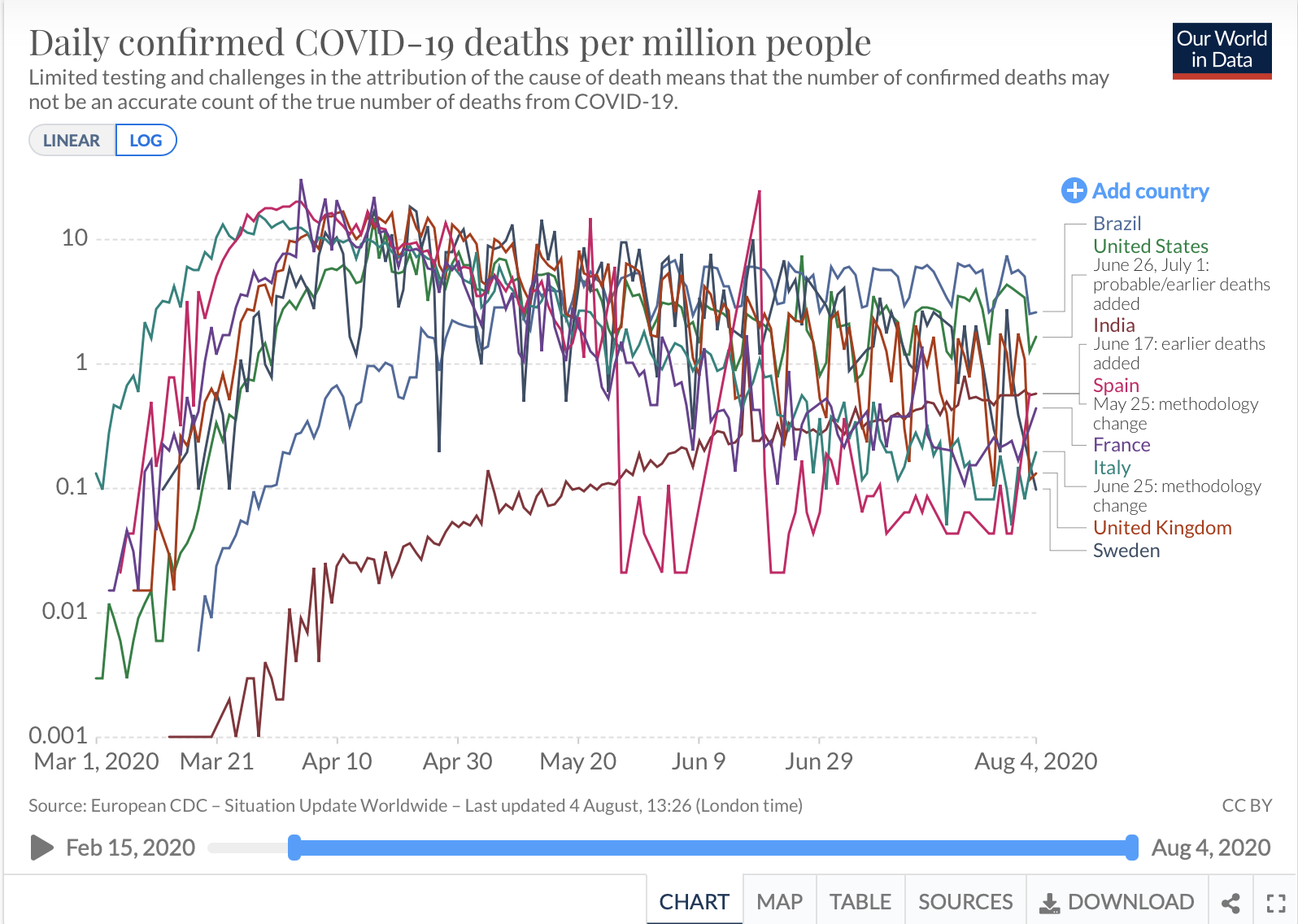
You are welcome. I think the whole point of this thread is to exchange information and facts, instead of bias. I totally agree on that. :) Trying to graph a linear curve of total deaths/million and log curves of daily deaths per million population - better done on your own device so you can highlight each country at a time. I'm attaching a snapshot from my screen. Per CDC total deaths per million for NYC is ~2800/M; NJ 1780/M. Comparatively, each of these countries on the graph is is 680/M or lower. India is less than 50/M (certainly there could be virus strain effects or reporting issues rather than just the host immunity). We do know that NYC went through intensive social distancing after initial spread, rather than deaths ceasing from achieving herd immunity, so I doubt the death rate was maxed out until "herd immunity" was reached. You are correct that Sweden death rates flattened - however there could have been mobility reductions there as well; people do behave differently than what governments ask them to. Also trying to compare log rates of daily deaths/Million. Countries with lesser mobility reductions could include Brazil, Sweden and US, as compared w Europe or Asia. Here Brazil and US still have a log curve above 1 which tells us it is too early to predict max deaths here. Sweden however did have a log curve reduction in the daily deaths which I cannot explain. My take after looking at these is it is too hard to tell if there is true herd immunity, and likely not there, given that countries with lower mobility restrictions like Brazil and US have ongoing deaths with a per million death toll nowhere near even the NYC death rates. Apart from Sweden, the rest are not supporting the herd immunity thesis. Also, as long as large swaths of vulnerable populations remain, businesses and daily life will continue to be impacted and thus social distancing will need to continue. There is one thing that is not supporting my viewpoint. Nowhere has the healthcare system been overwhelmed twice. That would be a true second wave, which has not happened anywhere. That would be clear evidence of herd immunity not being present. Economically, I think Governments will keep opening up until that happens, they almost have no choice as financial life support will run out. I hope we never find out and you're right :) https://ourworldindata.org/covid-deaths https://www.timeout.com/news/new-tracking-data-shows-which-countries-and-cities-are-social-distancing-the-most-040920 https://www.cdc.gov/covid-data-tracker/#cases
-
Thanks for sharing in more detail Muscleman. Will look again at the info on different countries and states within countries as well with an open mind.
-
If by "death rate" you mean [confirmed cases]/deaths, you certainly seem to be right based on the data we have already. Cases also appear to be inflecting down in FL, AZ and TX. So, I'm very curious what exactly you mean by "herd immunity" and why you think we'll have it by the end of the August. Do you think the NYC already has it? I already explained in prior posts. NYC already had 24% people antibody positive in early April, so probably 40% now. Also research shows likelihood of 40-60% of entire global population who have never been exposed to COVID but their T cell can already fight COVID. So we are easily at 80% immunity in NYC. The proof is the 10k daily cases in March but no second spike in July. Now Texas and FL, with similar population size, have experienced what NY experienced in March, so in four weeks, the new daily cases should be sharply lower. I don't want to keep explaining things over and over. People who believe it will find evidence that confirms their view, and people who disbelieve it will also find evidence that confirms their view. My high conviction prediction is that by the end of August, the COVID situation is dramatically better. Then the Democrats will face tremendous pressure to reopen. Then Trump wins again in November. And to Dalal holdings, my prediction of the crash depends on many things and 6 month time line is just a tentative one. I have to revisit it later. I have high conviction that we are in the early stage of an asset bubble and I have high conviction that this bubble will burst. I have low conviction for the 6 month timeline. But as it approaches, I'll see it more clearly at that time. It is simply not a good idea to put your words into my month and say, yeah you agree with me and that the market will crash in 30 days and COVID will be gone in 30 days. I never said that. Again, I will push back on your thesis that herd immunity is developing muscleman. The NY serosurveys were of people out and about and willing to get serosurvey testing done, not a random sample IMHO. Secondly, if pre-existing immunity were to play a large role, those who have lived longer, or been more exposed like those in nursing homes or healthcare work, would do better. But those are the populations heavily impacted in this first wave. Also, simply having T cell reactivity does not prove anything; again the elderly are dying in larger numbers and they would be the most likely to have pre-existing cross reactive immunity. On the contrary, young children who have never been exposed are doing relatively well. I acknowledge you have repeated your conviction, but the purpose of being on a message board at least for me is to be open to contrary views and clarify my thinking. There is an important distinction between cases going down due to control measures of social distancing (which need to be maintained until herd immunity develops) and true herd immunity (where life and business can resume as usual). Beyond the theoretical disconfirmation, your thesis has also not played out in any country so far. Places that reopen without proper social distancing are having recurrence of infections rather than displaying herd immunity. Also, since you have been following this in China, can you offer any reasoning why the virus did not spread as much within China outside Hubei province as in the rest of the world? I've been curious about that. Is it just fake data or is there more? How has their social distancing evolved now?
-
Ok...So I guess "the crash" will be in 6 mo then... You also said schools will open in most states by September which is possible but depends too much on local politicians. I think new case numbers will improve from here on out (have likely peaked nationwide), but "dramatically improved" is questionable. Furthermore, hospitalizations and deaths will have a longer tail due to inherent delays. I definitely do not think there is enough data to suggest we are close to herd immunity as you've suggested. But none of this really matters economically as the damage is done particularly to the U.S. due to a much longer drawn out and larger in magnitude pandemic than most industrialized countries (second round of fiscal stimulus in progress...). Those second and third order (largely economic) effects of the pandemic will have a long tail... Let's put it this way, if the US daily new cases do not drop to 20k or below by the end of August, I'll apologize in this thread. How about that? I am pretty sure the infection rates will be going down near term, but predicting the infection rates really didn’t help much predicting the stock market at all. I also think come fall and in particular post Thanksgiving, the Infection rates will start rising again most likely. However by then, the election Outcome is likely more important for the stock market. No I don't think it will rise again in the fall to Thanksgiving. Maybe COVID will not help predicting the stock market but this is the COVID thread so discussion of COVID going forward should be the top priority here. @Muscleman - I have a healthy respect for you not having confirmation bias, and for others following Coronavirus on this thread (kudos to your stamina and patience). Trying to think about how this is unfolding in the 6-12 mo, or let's call it pre-vaccine timeframe. I do want to question your thesis. My perception is that the virus numbers do go down after a peak. Is that from herd immunity? No hard proof of that. I think it is more likely due to people changing their behavior and doing more social distancing once cases, hospitalizations and deaths in their vicinity go up. Whether a county or country's numbers are low or high, the same pattern seems to be prevailing. Up, then down, then up a little when behavior eases, forcing behavior change again. When will herd immunity be reached is a question I do not have any confidence in answering - likely sooner in lower income countries where people are forced to go out (at a high health cost), and likely much later when the vaccine arrives in other countries. The second order effects of that thinking are the economically I don't see activity going back to baseline, just petering at 70-80% of prior except for what can be done from home or online, until either vaccine is given or infection happens to a large % of people, perhaps 50-60%. So I'm preparing for a prolonged slowdown even if there is confidence that numbers will go down, because they will go down due to social distancing and reduced activity rather than everyone being immune and being able to do whatever they'd like to do. In a sense, pain and losses mounting slowly but surely on the economic front. I actually think on the health front we may end up doing ok with less flu deaths and a lot of people being cautious in the wintertime, but I've been wrong so much by now I've stopped trusting my own predictions!
-
FNMA and FMCC preferreds. In search of the elusive 10 bagger.
DocSnowball replied to twacowfca's topic in General Discussion
Have been thinking of the same. Or even if it is a win but the monetary relief is a nominal $1