nafregnum
-
Posts
300 -
Joined
-
Last visited
Content Type
Profiles
Forums
Events
Everything posted by nafregnum
-
A little book report, for anybody who likes to geek out about contributions of neuroscience to the development of AI. Author is Jeff Hawkins, one of the founders of Palm Computing. In 1986 he was very interested in studying neuroscience and AI for speech recognition, but back then his ambitions were way too big for the PhD board in the neuroscience department of [Cornell or Berkeley, I don't remember which, maybe both] https://en.wikipedia.org/wiki/Jeff_Hawkins He tells a story of how he gave a presentation to Intel leadership that predicted everyone will one day be using handheld computers and getting a skeptical reception. After Palm Computing, he founded a neuroscience lab called Numenta. One day, holding a coffee cup, he asked himself a few thought experiment type questions about what his fingers would expect if he adjusted his grip on the cup and what would be going on in his brain as he did so. He had a eureka moment about how it all fits together, and called it the Thousand Brains theory of intelligence. It has to do with "cortical columns" which are like small 1mm x 1mm squares of lasagna layers spread out all over the neocortex. One cortical column will be tied to a little patch of nerves in a fingertip, another tied to a small patch of input from the eye, etc. In each cortical column, the top layer is made of neurons that receive the direct sensory inputs and they fire almost nonstop with the "blooming buzzing confusion" of constant inputs from the outside world. Traveling down the lasagna layers in each column, the neurons are firing less and less often because each layer is "refining" its prediction about what inputs will come next from above based on which "reference frame" the brain has chosen as the best prediction for what the current context looks like. To borrow a metaphor he doesn't cite in the book, think of that poem about the bunch of blind men who encountered an elephant, except imagine that they each share what they feel with each other and then vote on what it is that they're all encountering. A voting process among the deeper layers of the cortical columns help us determine where we are at the present moment and activate a reference frame kind of like a learned map of the territory. He has a pretty decent chapter which patiently explains why "uploading your brain to a computer" is a fun sci-fi concept but is pretty much problematic even if it one day became possible to do atom-by-atom scanning of a person's brain. One example: You would have phantom limb syndrome for every part of your body all at once unless you virtualized the entirety of your nervous system. He explains how all the current work in AI hasn't delivered any actual "intelligence" yet, just machine learning. He believes we need to be using everything we're learning about our neocortex brain structures to make better advances toward a real kind of intelligence, perhaps by aiming to produce a machine as smart as a kindergartner at first. He explains how we have an "old brain" from the 100 million+ years of evolution when the name of the game was just staying alive and reproducing, and that we do not need or want to reproduce the old brain in machine intelligence, so the future intelligent machines wouldn't develop fear of dying when being turned off. He believes we humans with our old brains are much more likely to cause our own extinction than to create a Terminator type future (overpopulation, nuclear annihilation, making earth uninhabitable among the threats). Intelligent machines would be more capable than humans at establishing a hypothetical 2nd home for humans on Mars because they could deal with the radiation and lack of atmosphere while they do their jobs to build things or dig tunnels or whatever the job requires. The book steers into some fun sci-fi musings in the last 3rd. One chapter near the end is titled "Estate Planning for Humanity" ... he suggests that in the billions of years of time in our universe, intelligence like ours may spring up from time to time and only last a brief moment before the candle flame goes out again. So as we look for signs of life out there, the odds may be against us that a similar kind of intelligent life would be "awake" at the same time as us, so he suggests we should develop some kind of long lasting beacon in our solar system which would be capable of signaling to distant observers that intelligent life was once here. Think: some kind of window blinds orbiting the sun which block/diminish its light in a regular intelligence-signal pattern -- something which could function for millions of years without maintenance. Fun sci-fi thoughts if nothing else. If you've read it before, or do so in the future, I'd love to know what you found interesting!
-
Any tips for deciding when to sell options?
nafregnum replied to nafregnum's topic in General Discussion
Thanks @LC, I ended up selling 9 of the 10, so I can still watch the one just for the fun of seeing what happens. -
Three months ago, I bought a few META calls ($200 strike June 2024 expiration) for around $6/share and they're quoted at $38/share today (up 120% just today) I'm pretty inexperienced in how options behave, but from less fortunate experience I think I've learned that they swing big on surprises and then when the volatility calms down their value drops a LOT. Here's how I think it works, is this more or less right? Decision 1: Sell today and take the 500% gain, because the value of these options is bound to drop a lot in the coming weeks. Decision 2: Hold on longer, hoping that the price goes above at least $238 before June 2024 in order to beat the current gain. For some of you more experienced with options, is this a complete no-brainer?
-
Hmm... Is there a chance that a lot of the tech whiz kids of today will contribute meaningfully to real value creation if there's a meaningful exodus from Cloud Fart Coin Land?
-
@changegonnacome you absolutely slayed me with the reference to Fart Coins, thanks for a good laugh. I had to google to see if it was real, and started laughing even harder. Couldn't help but share it
-
That's what I was pondering. I'm curious what the big disappointment was, but the last time I bought was at $93 and I don't mind adding under that level.
-
+1 to these thoughts. I'm finishing a book called "The Delusions of Crowds", full of examples of financial and religious manias. One of the superpowers of homo sapiens is our capacity to imitate. Some ancient hunter figures out how to make a better kayak or spear and the idea spreads through imitation. Narratives and beliefs spread in similar ways -- if your friend "knows" something and tells you about it, then you might now "know" it too. The Economist recently had an article about how a bunch of people have gullibly accepted the rumor that some public schools are now putting cardboard litter boxes into the bathrooms for the children who believe they are cats and dogs. It's like how parents began to believe that halloween candy needed to be X-rayed first to make sure no razor blades were hidden in the snickers bars. Fake news travels 7x faster across social media. Surprising and dramatic stories run on their own legs. On a daily basis we are told that the planet is heating up and dying. That's a dramatic narrative if there ever was one, and tweaking and repeating this tale is a boon to news media which now has a perennial scare tale to tell, with the added benefit that they get to feel righteous for telling it and thus doing "their part" to fix the problem. Really they're just scaring masses of people into feeling horrible about that extra minute of hot shower or leaving the lights on or using straws. Religious narratives used to help humans to deal with the existential dread of looking forward and seeing the certainty of one's own death. Religious belief is waning across much of the world, leaving many people exposed to the terror of death, but now it's even worse than in centuries past because we are also invited to consider such thoughts as (1) the death of all humans, (2) ecological collapse, (3) the eventual death of the sun, (4) the heat death of the universe. So... the world is ending on one hand, and I'm to blame because I take hot showers and have air conditioning and do 1,000 other earth destroying things each day. That's a stressful psychological state to maintain. Hating on fossil fuels provides a release valve for some of the psychological pressures, regardless of the obvious hypocrisy. In a lot of ways, fossil fuel companies are the scapegoat -- people are transferring their own "sins" onto the head of the scapegoat to ease their feelings of guilt. It's like they are the new tobacco companies. The recent Rolling Stone article was a transparent example. Externalizing blame. Virtue signaling. Denial. No invitations to self examination, no calls for reducing consumption here in North America. No concept of the second level effects that would result from "punishing" big oil. Very little understanding or respect for economic principles or history. But it sure feels nice to be righteous and to know who is to blame! Burn the witch!
-
One more, both of these videos were over on dataroma.com commentaries tab at this link ... https://www.dataroma.com/m/comm.php So, housing is 40% of core inflation. There's a backward looking measurement of housing costs, and there's a forward looking measurement. The forward looking indicators are down, but the Fed uses the backward looking indicators which are 'still' up... If the FFR is a forward looking policy tool, Jeremy Siegel here says they ought to be using the more forward looking measurements when deciding on what to do next.
-
David Katz (I don't know a lot about him) definitely believes we're near the bottom.
-
I've had this vague sense of worry for a few years, and Kuppy wrote it here a lot better than I could've done (see below). It seems like The Fed needs to talk a big game, because they know that there's no way they could actually allow ALL of the US national debt to roll over to a much higher interest rate. Think of the old advice to "Talk softly and carry a big stick." The fact that JP is talking loudly & tough may be hiding the reality that they don't have a big stick. I seriously wonder: What can they do if the tough talk doesn't scare away the inflation? https://adventuresincapitalism.com/2022/10/09/the-fed-is-fuct-part-4/
-
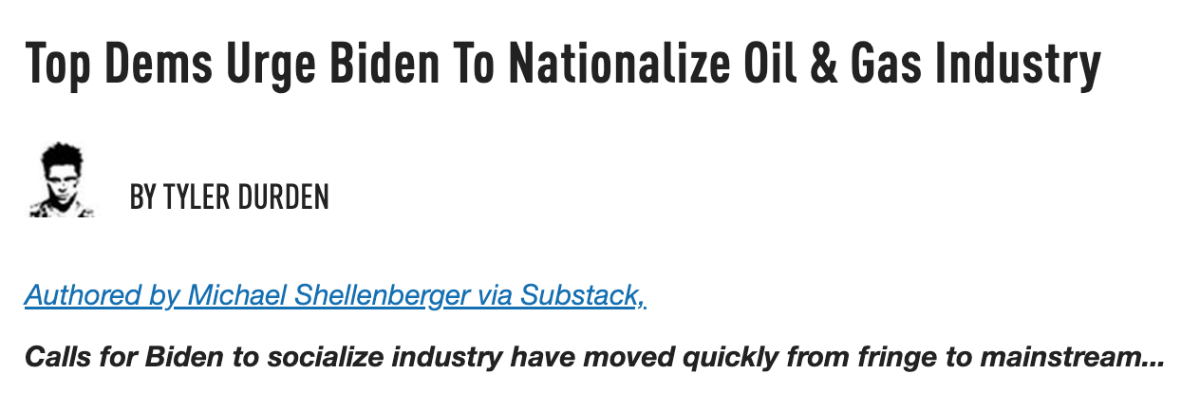
Yeah, I'll have to watch out for Michael Schellenberger articles in future and put on my skeptic hat when I do. Bordoff definitely isn't calling for nationalization, a fact which Schellenberger could easily have verified if he cared to ask around. That's just the wild west we get from substack journalists I guess.
-
Jason Bordoff turns out to be someone I have listened to a number of times on the Columbia Energy Exchange podcast, as he's one of the hosts. He's definitely not in the same category as the guy who called for nationalizing US oil back in July. The zerohedge.com article seems to be scaremongering because the title is "Top Dems Urge Biden to Nationalize Oil & Gas Industry" but Tom Nelson was already someone who dropped out of his senate race in July, 3 days after posting his op-ed in captimes.com, a Madison Wisconsin local newspaper. Not sure that qualifies Tom Nelson as a "Top Dem" ... and Jason Bordoff's talking points were anything but calls for nationalization. Tyler Durden and Michael Schellenberger are the authors of the unfounded claims and ought to be ashamed of themselves for writing click bait like that ; ) (you have to put an email in to get a free-to-read link, a form of paywall I didn't mind as much as some of the others out there) https://www.foreignaffairs.com/articles/energy/2022-06-07/markets-new-energy-order Including last couple paragraphs:

-
https://captimes.com/opinion/guest-columns/opinion-tom-nelson-lets-nationalize-the-oil-industry/article_896e77ba-e1dd-52e5-9f75-eeaef21ef8f3.html Well, the other guy Tom Nelson, was running for senate in Wisconsin but already bowed out, just 3 days after the July 22 date on his newspaper opinion piece calling for nationalization. Perhaps it's an idea so distasteful that this had something to do with it. The Dems want candidates who can win, and candidates who call for nationalizing oil might be seen as way way too politically risky. As it stands, the Economist is saying they think the Republican, Ron Johnson, will win in that race. https://www.economist.com/interactive/us-midterms-2022/forecast/senate/wisconsin
-
Here are the last few paragraphs from the piece Bordoff co-authored for The Economist. It seems reasonable that they suggest low interest loans or some other mechanism for government to encourage the building of new fossil fuel energy assets which may not reach ROI before they're decommissioned (like refineries, terminals) ...
-
This scared the pants off me, so I went to twitter to see if anyone else said/heard this. Bordoff offers clarification here, saying he's never called for nationalization of the companies. I'm off to read the Economist article he refers to ...
-
(Fun fact I learned yesterday) Greed springs eternal! There was no crypto back then, but they did have the original Charles Ponzi. "Under the heading of his company, Securities Exchange Company, he promised returns of 50% in 45 days or 100% in 90 days." https://www.investopedia.com/terms/p/ponzischeme.asp#:~:text=Origins of the Ponzi Scheme,Howe in the United States. (Learned it from a great book called "One Summer" about all the amazing things that happened in the summer of 1927. Ponzi was mentioned, even though his scheme happened in 1919 and 1920. Bill Bryson is a fantastic author, for anyone who hasn't heard of him.)
-
Everything in this space is up 30%+ today on news of a Federal pardon of all simple possession convictions.
-
On the eve of Buffett's 92nd birthday (08/31)
nafregnum replied to Buffett_Groupie's topic in General Discussion
Thanks for the link. Good read. In 2015 I went to the 50 year shareholder meeting in Omaha and made the short drive up to his modest house to take a picture there with my wife. The humility of acknowledging that he won the ovarian lottery, rather than diminishing his achievements, only makes him a greater human in my eyes. I learned from him to approach my own successes in a similar way, attributing much to good fortune. When I was a teen, I memorized a bunch of old proverbs, like, "A man all wrapped up in himself makes a small package" and "A pig with a golden collar is still a pig" ... if I could wish for an investing superpower, it would be the ability to measure the humility and honesty of executive teams. I've lost too much money buying shares of companies that were cheap but turned out to be run by Gucci little piggies. -
+1 to Shane Parrish and his "Knowledge Project" podcast, as well as his "The Great Mental Models" books. A real classic, something I consider to be a class in "defense against the dark arts" for decision making, is "Influence, the Psychology of Persuasion" by Robert Cialdini. https://smile.amazon.com/Influence-Psychology-Persuasion-New-Expanded/dp/0063138808 One more book I really enjoyed is "How We Decide" by Jonah Lehrer. It apparently went out of print and is expensive now, but you can probably find it at libraries. Each chapter started with a very memorable story to introduce the concept. https://smile.amazon.com/How-We-Decide-Jonah-Lehrer/dp/0618620117
-
Where Does the Global Economy Go From Here?
nafregnum replied to Viking's topic in General Discussion
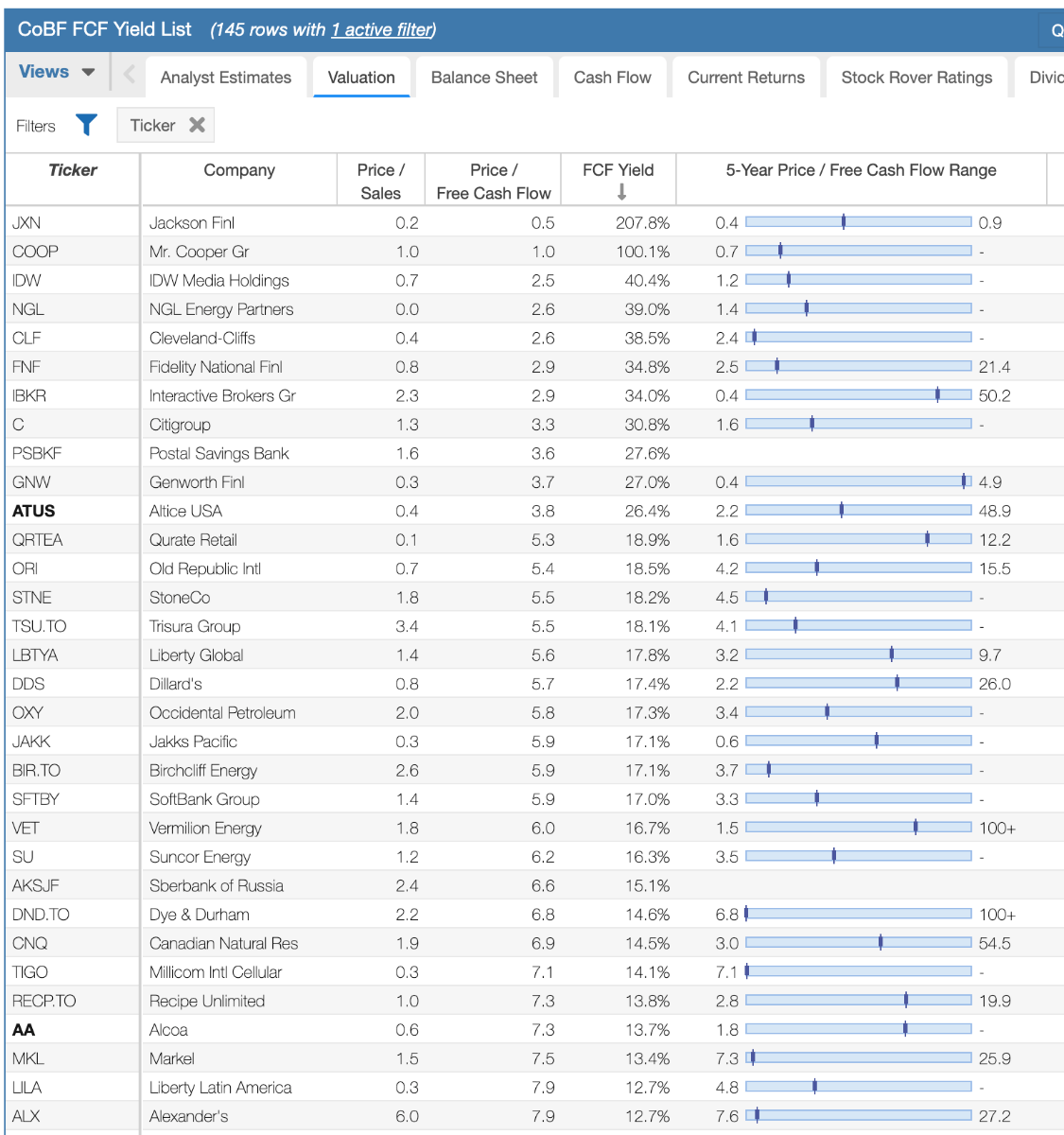
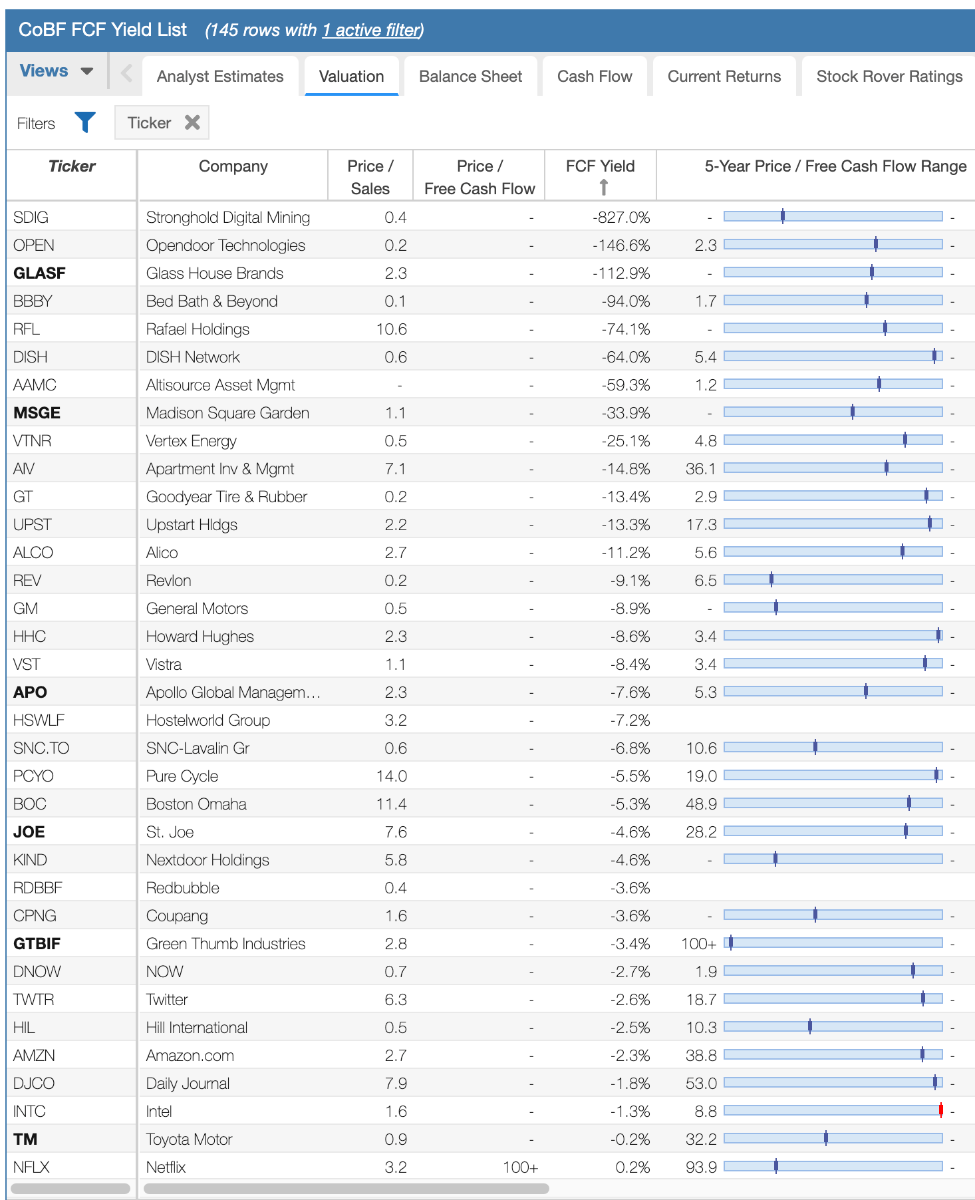
I'm interested in what you're saying, @changegonnacome, so for curiosity sake, I made a watchlist out of the last five or six pages of "Investment Ideas" and then sorted the list for "Best FCF Yield" and "Worst FCF Yield" in the screenshots attached. Also attached, the csv file which can easily be imported into a Google Sheet if anyone wanted to examine the whole list or sort on a variety of different rows... I'm not familiar with all of the threads, but Do the "best" and "worst" seem like the most and least likely to see price improvement in the next 36 months? Watchlist CoBF FCF Yield List 46 rows with 1 active filter - Valuation.csv
-
Where Does the Global Economy Go From Here?
nafregnum replied to Viking's topic in General Discussion
I really laughed when I read this. Then I said to myself "I wonder if Gregmal made other funny jokes this morning, so I clicked on the profile pic, and noticed it said "10,004 posts" ... so I want to just say "Happy 10,000th yesterday!" I appreciate all the thoughts and ideas, the serious and the silly. Your contributions and contrarian takes are valuable and keep the conversation rolling along and lively. Here's to your health, Gregmal, and to many more investing successes and funny hot takes. -
The headline thumbnail is terrible -- I just found it fun to listen to him talking big picture for a few minutes there. Especially liked the bit about how Envy has made all of us humans unhappy even though we're about 600% more well off than 100 or 200 years ago... Don't know of any other 98 year old with this much clarity remaining. Sure will be fun if he makes it past 100.
-
Title: "EU seeks windfall tax for electricity groups well below market rate" https://www.ft.com/content/ab469e2d-8e87-44ee-855b-f46b5b2dd17e "Wholesale electricity prices have rocketed because they are pegged to the price of gas, whether or not the power is produced from gas or other sources. Gas prices are roughly 10 times higher than they have been compared with averages over the past decade as a result of Russia’s supply cuts in response to western support for Ukraine." What I found interesting is this: They're talking about charging windfall tax on power sources like wind and solar since their "input costs" have not gone up like gas, yet it is being priced as if gas was one of their inputs. When you consider that there were likely big government handouts to get those renewables projects up and running, I personally think this seems like a reasonable temporary tax on the electricity being generated by the non-gas non-coal power sources. Previously, I worried a windfall tax in the EU would punish my investments like Vermillion (VET) but the current discussion seems to be different over there than when "windfall tax" was thrown about in the US and Canada recently.
-
Economist's podcast -- Money Talks: Running on empty https://overcast.fm/+JXrTojdeI High electricity bills (4x, 5x or more!) can only get people to cut back usage so far, so the opinion expressed in the episode is that government intervention of some kind will be necessary to deal with this. Scottish Power president: "A price freeze and a price intervention is not an end solution. The purpose of it is to help people directly, absolutely, but what you need to do is have a whole other series of measures for the medium to long term that resolve the issue... Disaggregating the cost of gas and electricity, so that you get cheap renewable power through. Price intervention is not an end solution, it's a short term mechanism to buy you time to fix the problem." One conclusion quote from somebody: "The combination of having retail prices reflect the scarcity, and being very generous, particularly at the bottom of the income distribution with a cash handout, I think is the best solution." It does seem like the entirety of electricity generation should not be priced according to the highest marginal producer. If 80% of Scottish electricity comes from renewables + nuclear, then there ought to be a way to reflect that in consumer bills, like charging the first 600 kWh used at the previous power rates. 4x or 5x higher energy bills might be a problem big enough that they'll need to think differently to solve this, because it seems like Putin is exploiting a built-in weakness in the way the electricity market is currently configured.
-
Where Does the Global Economy Go From Here?
nafregnum replied to Viking's topic in General Discussion
The expectations are way off, partly because of a side effect of social media. This is my favorite online essay about that. https://waitbutwhy.com/2013/09/why-generation-y-yuppies-are-unhappy.html I love the formula given: Happiness = Reality - Expectations