thepupil
-
Posts
5,006 -
Joined
-
Days Won
6
Content Type
Profiles
Forums
Events
Everything posted by thepupil
-
- in general, i also hate when people tell me why non-GAAP isn't appropriate, but with respect to the minor tax adjustments, I know you understand why it's not crazy to make those. - Berkshire's mix of businesses don't get refreshed? I think Berkshire probably has a higher turnover of company's as a % of earnings than SPY the past few years. Berkshire isn't an individual company. It's a portfolio and becomes more diversified (for better or worse) every year - I agree with your negative assessment of the S&P 500, which is another reason why i'm excited about berkshire. I think without a re-rating of book, berkshire will outperform the S&P over 3, 5, and 10 years on earnings growth alone, EVEN at a low rate of reinvestment. - i also agree with you that OCI will be lower. 1% from OCI implies about 3% capital appreciation of the stock portfolio (a reasonable long term expectation), but as you point out probably not a reasonable short term 1 - My $24B figure was pre-tax earnings spitball going forward and not an indicator of cash flow, or free cash flow or anything; it also takes into account PCP and Duracell coming on line. That being said, if $20B is the number you calculate (which is GAAP earnings last year), then Berkshire is at a 6.25% earnings yield pre-PCP capital deployment, pre dividend increases at most major holdings. A greater than S&P earnings yield, with better growth, better management, no stock option leakage, excess capital (albeit much of that was just used, but they will very soon have excess capital gain with some sad maturations of above market preferreds), etc. - I think if you used GAAP net income as the way to assess Berkshire over its recent (and certainly its ancient) history, then you'd never have bought it. - you understand this better than your original post indicated, which I had a hunch was the case
-
So then you must be short the S&p500 which has enjoyed an increasing ROE since the 1970s and has 2x the ROE of Berkshire? Because capitalism works. Do you know what other comprehensive income is and why Berkshire growth in book value is greater than otherwise implied by its ROE? Do you understand why ROE is not reflective of the change in value of a securities portfolio? Do you know why Berkshire pays such a low cash tax rate and why GAAP net income may not be reflective of earnings power or free cash flow? you're looking at a somewhat complex beast of a company (though more understandable if you divvy it up in 3-5 parts) and using 1 statistic (ROE) to say it isn't exciting. You need to do more work to come to that conclusion (or explain your work better) *not really fact checked but I know to be generally true. Also the s&p actually is probably earning unsustainably high margins which is one of the reasons it's roe is so high
-
5-8% ROE? $240B equity $19B pretax non insurance earning + $5B pretax investment income +- underwriting income/ loss = $24B assuming no underwriting profit / loss 10% pre-tax, tough to see how you get down to 5%. And that's while holding $60B of cash and $27B of fixed income. Look at the cash tax rate the past few years. THEN add another 1-2% of other comprehensive income (not included in ROE but certainly a component of total increase in value) from stock portfolio price appreciation over time. And ROE will only increase as goodwill as a percentage of businesses decreases over time. BNSF 14% of book has an 18% pretax ROE, in 10 yrs the lubricants, building supply, and industrial widgets conglomerate that is non insurance non rail non utility Berkshire will earn higher ROE as the acquisition premiums paid in the past few years become a smaller percentage of the value of companies. The s&p has an ROE of like 16%, Berkshire owns a portfolio of good U.S. Based businesses. Over time ROE of the portfolio that isn't stocks (where equity gets repriced upward for increase in earnings powe) will only increase (assuming you think coroorate earnings will grow) I agree there are cheaper stocks out there. But a Buffett managed 70 cent dollar (or Buffett successor managed) is exciting and i really don't think " 5-8% ROE" is a meaningful or accurate way to think about it given the Drag of the securities portfolio on ROE (which will only include interest and dividend income since tax affected capital appreciation falls under other comprehensive income).
-
Nice, so using an alternative method of saying BNSF is worth 80% of UNP (since it currently has 80% of its earnings, so not baking in any kind of better than UNP growth/margin improvement), Morningstar would be at about $80B (rather than $96). Using 80% of UNP market value, it's $60B. Either way, the 14% of Berkshire's GAAP book value represented by BNSF, is worth 1.7X book using [uNP* 0.8], 2.3X book using [Morningstar UNP PT * 0.8] and a wopping 2.8X using (Morningstar PT). With Berkshire at 1.3X book, how can you not like those numbers? Anyways, I'm getting quite repetitive....
-
So there are 2.464B B share equivalents which implies the following morningstar valuations Insurance $135B KHC $24B PCP $34B BNSF $96B <--this seems a little high to me, unless you think BNSF is immune to the troubles of the other railroads* BE $37B <--this seems a little low to me M,S,R $96B Finance $15B $436B , 1.8X My roughly calculated base case a few pages back was about 1.9X which I think came from me being a touch too generous on the insurance. *UNP can be bought for 76% of Morningstar's valuation of BNSF...it has earned more in each of the last 3 years...if you believe m*'s BNSF valuation, then UNP is certainly a buy. Perhaps, I'm missing something about the differences between the two... UNP pretax: $6.3B, $7.0B, $8.3B, 1H: $3.8B BNSF pretax: $5.3B, $5.9B, $6.1B, 1H: $3.2B
-
I agree with you that some seriously imprecise language is being thrown around by yours truly. Perhaps I should have used NAV instead of "adjusted book". I think of BNSF and BE as public companies inside Berkshire (they file K's and Q's and have some decent comparables) and like to compare what those are trading for in the market to what I think I'm paying for them by buying Berkshire, but obviously I realize that UNP going down in stock price isn't going to effect the GAAP book value of BNSF; it may however reflect a decrease in intrinsic value or NAV.
-
How does the MV decline of a wholly owned sub impact BV? Also - highly doubt BNSF equity is financed with 1:1 debt/equity. Jay, see my posts. I think he means "mark to market book value" when he says "true book". MTM book for BNSF has certainly decreased with UNP, NSC, CSX and KSU all down significantly. XLI is also off 12% this year if we use that as a proxy for Marmon, Iscar, and the like. So it's fair to say that MTM book value of wholly owned subs has decreased, in addition to the decline in MTM value of the stock portfolio. BUT the MTM book value of those 2 subs was and is still WELL above GAAP book value. And KHC added a good bit after Q2 to help offset this, as will $23B or so of pre-tax investment income + operating earnings, plus whatever underwriting profit shakes out to be. and yes, BNSF equity is not levered at all. The company itself is levered, but the equity stake is definitely not!
-
BNSF has a book value to Berkshire of $34B. Using a simplistic analysis of the decrease in market value of BNSF (simply saying the "right" multiple has gone from 20X to 14X), then BNSF went from being worth $90B to $56B, from 2.3X GAAP book to 1.6X GAAP Book. It would be incorrect to say NSC is down 30%, Berkshire has 44% equity/ assets, ergo Berkshire's interest in BNSF is worth 60% less. BNSF is simply "worth" a less giant premium to book than before. That premium moves up in down in an unlevered fashion because Berkshire's equity stakes in BNSF and BE are not themselves levered like that. https://www.bamsec.com/filing/108131615000005?cik=1081316 Also BE has gaap book value of $20B, it's worth at least 1.5X that and quite possibly much more , and utilities are actually one of he beat performing sectors this q. Between the value creation that of occurred with Heinz Kraft transaction, the stability of BE, and the capital deployment of some of that cash that was fallow for so long (PCP plus some equity buys), I don't think Berkshire's adjusted book had declined all too much this year. True, BNSF would certainly be worth less as a public company today than at the beginning of the year, but Berkshire's price is also down a good -15%, so I think price / value has actually improved given the progress elsewhere. Check out all that high quality regulated free cash flow that comes online if BE stands still (which they won't, they'll instead plow that back into more regulated return assets).
-
BNSF has a book value to Berkshire of $34B. Using a simplistic analysis of the decrease in market value of BNSF (simply saying the "right" multiple has gone from 20X to 14X), then BNSF went from being worth $90B to $56B, from 2.3X GAAP book to 1.6X GAAP Book. It would be incorrect to say NSC is down 30%, Berkshire has 44% equity/ assets, ergo Berkshire's interest in BNSF is worth 60% less. BNSF is simply "worth" a less giant premium to book than before. That premium moves up in down in an unlevered fashion because Berkshire's equity stakes in BNSF and BE are not themselves levered like that.
-
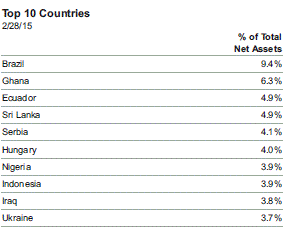
agreed, definitely generalizing...but 8% to invest in these places! I'd argue this is more equity like risk and the discount is more of an equity like discount ( a 10% discount for a US IG fund is a lot greater than a 16% discount for a Brazil Ghana Ecuador, hungary, Sri Lankan etc. bond fund).

-
from a risk standpoint these are very interesting. If you buy an unlevered bond fund for a 10% discount, you are insulating yourself nicely from a lot in terms of credit and duration risk (ie if you buy IG with duration of 5 or 6, you can have ~200 bps of rate rise, ceteris paribus, before your NAV is lower than what you paid, or if you buy HY you can take that much more in losses). The problem is that as going concerns, these high fee vehicles pay a big percentage of their upside to the management companies AND many of them are levered so you don't get as big of a cushion on an asset value basis than the discounts would have you believe. It's interesting that the equity market for vehicles with credit like risk (from lower risk IG and muni CEF's all the way to high risk BDC's) is telling us about credit and the economy...Someone has to be wrong. I'm still on the sidelines, but have been meaning to compile a shopping list.
-
Business Models--some of the best for small AND big businesses
thepupil replied to netnet's topic in General Discussion
my parents recently paid $1500+ to remove a giant beehive from their roof...was it exorbitant? Yes. Were my 60+ yr old parents going to get on a decently sloped roof in 95 degree florida weather in full body gear and remove a bee colony? Nope. -
i could see a decent bear thesis if it focused on 1) an over-earning BNSF (railroads have had a decade plus of increasing utilization and margins)...is there a secular decline in "stuff" that needs to be moved (ie peak car, peak coal, peak crude by rail, etc.) 2) low expected returns at BE (increased regulation, disruption of utility because of at-home solar and the like) 3) insurance mean reversion/skeletons the problem is those are giant big picture worries and really hard to analyze...i know i'm not equipped to do so. But i could see someone making a case along those lines.
-
"Deserve" is a wrong word. No, it probably does not "deserve". BRK is somewhat cheap while S&P is quite expensive at current multiples. So really the expectation is that S&P might rerate lower rather that BRK would rerate higher. Although some mix is possible. In other words, I'm interested to buy BRK (or similar great/good business) at 13X, but I am not that interested to buy S&P at 18X. well if you want to buy berkshire at 12X and with the investments for 30% discount to current price, and not pay any premium to book for the insurance (ie count the float fully), you'll have to wait for another 18% down. I'm personally not so patient. I think you are articulating that the S&P is absolutely expensive and that Berkshire is relatively cheap to the S&P. I'm inclined to agree with that but something that has 18% downside to a pretty bearish scenario, to me, is absolutely cheap, low risk and compelling. One funny thing is that Picasso mentioned he owns the stock. When I was the guy arguing for less bullish valuations, I also owned the stock...we need more negative thoughts from non-owners!!! Bear (recession*) : 30% discount to investments ($112B) + Dry Powder ($15B) + 12X Post tax Operating Earnings ($171B) + Insurance Book ($-36B) = $262B (18% downside, 110% of current book)
-
Picasso, it's hard for me to understand why Berkshire's businesses deserve to trade 5 multiple points lower than the S&P (you mentioned 13X earnings). If you weight the multiple according to their composition (just using last 6 months), I get to 15.8X (2.2 lower than the S&P) because the railroads have experienced a big re-rating downwards (coal volumes decline, oil, general economy, etc.). And I realize that when you plug in (S&P multiple) for large portions of it, you'll get a result that is close to S&P multiple, but 50% is BNSF and BE which have more precise comps. I don't really see any reason for 13X. Apple gets 80% of its profits from 1 thing. I can understand why some would discount that earnings stream more heavily than the S&P (no strong opinions on what that discount should be). But 5 lower than S&P seems egregiously conservative. And as someone mentioned, who cares about coke? He hasn't bought KO since like 1992, right? BNSF and BE together are worth at least 5.5X KO pre-tax. Run rate post tax GAAP earnings for non insurance is $13-$14B % of operating earnings Market Multiple railroad 35% 14 (UNP, CSX, NS trade around 14.5X, KSU at 20X) manufacturing 28% 18 (S&P) utility 14% 17 (just looked at a few utes, seemed to be between 15 and 20X) finance and financial 11% 12 banks are around 10-12X, this is mostly the trailerpark manufacture and de facto slumlord finance biz, which seems to be defensive and deserve decent service and retailing 10% 18 (S&P) mclane 3% 18 (S&P) weighted avg 15.8
-
awesome to see this guy go down. he vilified the short sellers who were for the most part right. made $10K on CBEH (China Integrated Energy) puts senior year of college. Felt like i was king of the world! Should've capitalized more on that opportunity and more like it but life got in the way and the bankroll was quite small.
-
For BNSF and BE, IRS depreciation is faster than GAAP depreciation. this defers taxes and creates a difference in cash tax expense and GAAP tax expense, which is represented by an ever increasing deferred tax liability. As long as BNSF and BE capex is greater than depreciation, this never "unwinds" and as long as BNSF and BE are investing at satisfactory returns, the capex needs are not a negative (and much of this is not "needs" but true growth in earnings power). There may be other, smaller, less important businesses within berkshire where the same dynamic is at play. BE Energy 10-K (page 104 cash flow statement), in most recent year net income of $2.1B gets a nice $2.3B addback "deferred income taxes and amortization of investment tax credits" https://www.bamsec.com/filing/108131615000003?cik=1081316 BNSF 10-K (page 19) https://www.bamsec.com/filing/93461215000005?cik=934612 Deferred income taxes add back of $900MM on NI of $3.8B here is a good article, explains the P,P&E related DTL nicely http://seekingalpha.com/article/2428045-how-buffett-is-changing-the-future-of-berkshires-float-from-insurance-to-uncle-sam the 25% may have been a little "finger in the air" but it's what i recall from my past analyses of the two companies. I do not keep detailed models on these subs, admittedly. But a full 35% or 30% is not correct. Outside of the operating companies: Appreciation of equities causes tax expense and no cash taxes and an increase in DTL. Berkshire does not sell stock (mostly) and does not pay taxes when they do (they tend to sell some losers). At Berkshire level (which combines the BE/BNSF Accelerated depreciation/PP&E related DTL with the equity appreciation DTL, you can see cash taxes as % of income tax of 50-60%) cash paid for taxes last 3 years: $4B, $5.4B, $4.7B Tax expense: $7.9B, $8.9B, $6.9B EDIT: BE's tax rate (just using income tax expense, not cash) is just plain low in general (9-22% over the past 3 yrs) BNSF's cash tax rate was 22% last year. the rest of the non-insurance subs bring up the average but 25% seems like a good estimate.
-
FWIW, when i updated my numbers recently for the market movements and PCP, here's kind of where I stand after deciding I was being too punitive on the cash and fixed income requirements of the float, which added $33B to my rough valuation (I previously assumed cash & fi = float and now assume FI + $20B cash = float, what rb suggested in the other thread). I see Berkshire as very positively skewed in terms of its price / value. Earlier in the year when it was at $370B and I was ~$30B lower in all my valuations, I thought it was a 90 cent dollar. Now I'm back to thinking it's a 70 cent dollar since the stock is off 13% since then and my value is higher. Thus, I've greatly increased my position. You all can laugh at me for trying to "trade" in and out of berkshire, but i do try to re-balance amongst my other holdings according to best risk/reward and p/v. I know this may be heresy for the more devoted. $130B equity portfolio (per bloomberg) $8B Heinz pref $22B other (BAC, Wrigley, Dow etc.) $160B Listed equity and other $60B of cash - $20B PCP - $5B Heinz equity injection = $35B cash - $20B working capital requirement = $15B dry powder , as I said on the other thread i'm being less punitive going forward I get to $19B of recurring pretax earnings after PCP (note that I'm deducting non-allocated interest and a projected new holdco interest from $10B of additional debt taken on for PCP). At a cash tax rate of 25%, that gets us to $14.25B post tax earnings Insurance $83B of float $27B of fixed income + $20B of cash This "division" has -$36B of book value. Using 1% yield on investments and 3% UW profit gets you to about $3B of "expected" pre-tax profit. We can say that's worth positive $25B, for our bear case, we'll use the "due tomorrow" book value method All in all: Bear (recession*) : 30% discount to investments ($112B) + Dry Powder ($15B) + 12X Operating Earnings ($171B) + Insurance Book ($-36B) = $262B (18% downside, 110% of current book) Base (normal**) : investments @ market ($160B) + Dry Powder ($15B) +18X Operating Earnings ($256B) + Insurance ($25B) = $456B (42% upside, 190% of current book) Bull/BlueSky : maybe say the operating earnings are worth 25X? which would add 7X 14B = $98B = $554B (72% upside, 230% of current book) *Note I did not impair the earnings in the bear case which may be appropriate, but I think using 12X though is punitive enough, but I could see arguing for a little more stressing. **Why 18X? Well that's where the S&P trades and reasonable growth should be expected. When i put together my numbers after 2013 i got to $15B pre-tax non insurance earnings and now i get 19B after PCP, about 10% growth over the two years, which is kind of what i expect...you could argue S&P growth much lower than 10%, ergo berkshire worth more, but I'll leave that for the bull case
-
http://finance.yahoo.com/news/warren-buffett-plans-invest-32-163654606.html RB, in support of your argument, Warren continues to reiterate the $20B cash as his minimum (which if you count all fixed income as working capital for insurance) means Berkshire needs to keep ~$50B in cash and fixed income around, leaving him $10B more after PCP deal to buy stuff. One way to reconcile the $20B minimum with the much larger level of hoarding (the hoarding as the slide i posted shows float = cash & FI), is that it doesn't make sense for Berkshire to deploy small bits of capital into new businesses (ie a $2B acquisition does nothing). So there is a lag between when cash gets invested and as it builds (what a boglehead would call "cash drag"). While this is a negative over time, it's not nearly as bad as having to keep the full value in cash. So i revise my position on the float requirements in favor of the more bullish to $50B rather than $80B. Longinvestor, rb, others. Enjoy this moment. I bought more Berkshire today. All that arguing made me realize that even though I'm less excited than others, I still believe berkshire is very undervalued and it is just as undervalued as lots of other things i own.
-
I own the stock, rb. I think we are on the same page. I think the company is very undervalued, just laid ou some reasons why I think operating earnings won't grow at the rate they have. The funny thing abou Berkshire is we're basically arguing whether or not this company has 30-40% upside to re rating or 100%, either way the stock is a buy and a half. I/we spilled a lot of ink about this and that because I'm an argumentative disagreeable person online and had an opinion that I wanted toe express and but you're right, who cares? We're all getting to buy a great company at a good (or awesome if you are more bullish) price. Other threads are arguing over whether x co's earnings are real or this or that. We are arguing whether op earnings growth will be 10 or 12% or 18%. In either scenario Berkshire's is a great stock to own and will provide a more than adequate return without a lot of risk.
-
No thanks to the modifications. it is precisely because of the spectacular growth from 2010 to 2015, that I'm willing to bet on it slowing and it being more difficult to grow. You are correct, there is currently no evidence of it slowing. Investment is a forward looking process. It's my proposed bet so I don't understand how I'm "moving the goalposts as in staring down the barrel" (as a shareholder throughout most of the past 4 yrs I'm celebrating wih you, not staring down a barrel). Pre BNSF non insurance earnings were $6-7B, they bought Burlington when it was earning $3b, BNSF then doubled earnings (economy improved, shale and crude by rail ramped up), so BNSF basically doubled the non insurance earnings. That'd be a lot harder now that we're at $18B. That's all I'm saying.
-
I realize I should let his go, but I'm in an airport so I've got a little free time. My whole point for blabbering on about this is that if you give the operating companies a really fat multiple (and its historical growth rate, if self funded, would indeed deserve a massively fat multiple), and you give full credit to investments / share you'll end up double counting. To use BNSF as an example (because BNSF basically doubled run rate operating earnings it's very important) BNSF consideration of $34B - 23% of already owned stock ($7.8B) - $16B cash, half borrowed - $10B stock (at the time Berkshire was probably 70/30 financial / operating in terms of value so let's call this $7B from financial. I think it's fair to say at least 1/2 came from financial side of Berkshire. Now there is nothing sinister here, the investments aren't being bled, they e still grown at a great rate, blah blah blah. But you just have to put the growth rates in context. Now in your valuation above, you apply an 18 multiple to the operating companies, so you are not double counting and despite violently disagreeing with practically everything I say you come out to a price target that is pretty close to mine. But if you were to say "the operating companies are with 30x because of their growth rate" then I'd say you're getting way aggressive and double counting. You aren't saying that though.
-
Sorry but I feel the need to defend myself a little here... I think slide 9 illustrates the increased size of operating earnings relative to the insurance/investment related earnings quite nicely. The biggest jump in non-insurance earnings come from big acquisitions (most notable BNSF) which was funded with already owned BNSF stock, cash that was FAR more than the previous year's operating earnings (though to your point he borrowed 1/2 of the $16B of cash) and Berkshire stock. They bought lubrizol for $9B a little later which was like 100% of non insurance operating earnings. They've made big purchases in utilities, far more than they could have if BE was separate. Insurance/financial income has gone from well over 100% of non insurance income to about half (and continues to decrease with things like the $20B of cash that will be deployed in PCP (it's $30B cash, but they are borrowing $10b of that, I think) I really don't understand why you are saying "I'm way off and completely wrong" when all I'm saying is the ability for financial Berkshire to subsidize operating Berkshire has markedly decreased because operating Berkshire has grown so wonderfully in size and earnings power. This seems me to be a factual statement. Is it not true that if Berkshire did a similar size deal to BNSF, and a similar amount of already owned stock and cash was contributed from Berkshire financial side of things, that Bon insurance earnings would grow by a smaller % than in the past? I have never said this is a bad thing. It's a great thing. I, like warren, prefer the tax efficiency and control of wholly owned earnings streams to passively owned ones. And I think both sides will thrive and they have. The conversion of stocks to businesses and the diversion of investment and underwriting income into businesses is great. http://www.tilsonfunds.com/BRK.pdf
-
I always add back the DTL. I said I eagerly await insurance losses (because it would lead to market share growth and industry stress), not in fear With respect to the float, I don't think discounting for the working capital requirement is retarded. Your tone seems a bit angry. We both own the stock; you are more bullish than I. It's beer time
-
Also, I did not fully deduct depreciation and amortization. I gave them credit for the tax shield by saying earnings were $11-$12 B post tax (which implies a low tax rate for that year. But whatever.