mattee2264
-
Posts
786 -
Joined
-
Last visited
-
Days Won
7
Content Type
Profiles
Forums
Events
Everything posted by mattee2264
-
I am referring to the next "bottom" before a new bull market resumes. That does not rule out future bear market rallies which might take markets higher. Is it possible that we will never see the S&P 500 fall below 4000 i.e. a V shaped recovery similar to the one we saw in 2019 and 2020? Well anything is possible especially if sentiment trumps fundamentals or the Fed/US government launch massive stimulus packages. But the latter seems unlikely and even the positive sentiment lately has been based on economic data that looks rosy on the surface and reading too much into Fed comments so I expect sentiment to sour as the Fed holds firm and we start to see job losses, stickiness to inflation and corporate earnings continue to decline.
-
If history is any guide markets will bottom some months before the economy bottoms and some months AFTER the Fed pivots. I don't think anyone has bragging rights at this point because it is too soon to tell whether there will be no landing, a soft landing or a hard landing and that is ultimately going to drive what the next bottom is and whether it will be above or below the bottom we saw autumn 2022 at around 3400 on the SPY. But if I had to hazard a guess I would say a soft landing might see us get close to 3400 and a hard landing would get us close to 3000 and no landing might get us close to 3800 as I suspect with no landing rates go a little higher. But of course all bets are off if there is a massive bailout from the Fed/US government
-
To add another point to the equity risk premium discussion: the bond yield is the bird in the hand while the birds in the bush are uncertain. Even the current earnings may well disappoint. So if you think you are getting a 5% earnings yield and earnings fall as they are prone to do during a recession you may well be disappointed and part of the reason for demanding a risk premium is to insure against such possibilities.
-
Agree that it is ridiculous to try to be so precise with the timing. But I don't think any of the fundamentals have changed and if anything they have deteriorated. What has changed is that markets seem a lot more confident there will be a soft landing and a lot more confident that we are near the end of the rate tightening cycle and the Fed will soon pivot. And forgetting that a soft landing isn't going to help bring inflation down and will probably necessitate further rate increases. In other words it seems likely it is a sentiment driven bear market rally.
-
For the past decade the Fed has been bailing investors out at the first sign of trouble and interest rates have been persistently low and a low growth low inflation environment has been very favourable to secular growth companies who've been able to juice returns by buying back lots of shares. And they even admitted that they were deliberately suppressing interest rates to encourage investors to chase returns and bid up risk assets such as equities to generate positive wealth effects. We had a soft landing in 2015 and 2018. In 2020 unprecedented monetary and fiscal stimulus saved the day. And somehow even with successive rounds of QE and persistently low interest rates inflation remained low. Until it didn't. So ignoring the noise and buying the dips was the winning strategy and the higher your equity allocation the better the results. So understandable that markets are somewhat complacent and assuming there will be an immaculate disinflation with a soft landing and even if something does break the Fed will go back to QE and all will be well. But who knows perhaps a decade from now it will seem obvious that the Fed withdrawing liquidity through QT and taking interest rates from zero to 5% or higher and keeping them there longer than the market initially expected would result in a lost decade with negative real returns.
-
Agree if you are picking your spots it matters less. Value stocks for example often do quite well during inflationary periods. But of course the big winners this bull market that still dominate the indices are the growth stocks which are quite sensitive to interest rates and inflation and have seen a pretty big rebound because markets seem to be quite confident about an immaculate disinflation and a Fed pivot. And as a lot of the long bull market has been driven by multiple expansion based on low interest rates and the idea that TINA to equities then a moderation of market multiples and a re-allocation towards bonds doesn't feel like a supportive environment for equities especially if earnings fail to hold up. And interestingly it is a similar dynamic. At first people were reluctant to price up equities even though interest rates were near zero post GFC because they thought zero interest rates were temporary. Then they got comfortable with the idea that interest rates would stay low and the Fed would cut at the first sign of trouble and multiples drifted above 20. Now even though interest rates are a lot higher people assume it is just transitory and they will fall back down once inflation is tamed and are still pricing based on a low interest rate environment. Perhaps again it will take time before people start to believe that higher (but still quite moderate by historical standards) interest rates are here to stay and adjust multiples accordingly.
-
Buffett always hedges his opinions on market levels by saying it depends on interest rates and interest rates are like gravity on financial assets. But we don't really seem to be seeing that to a large degree. 30 year US treasuries have increased from 2% at the end of 2021 to almost 4% today and could well head higher than 5% as most of the so-called disinflation just reflects energy prices coming down because the US are draining their SPR. The SPY peak was around 4800. That represents around 23x TTM earnings of $210 a share. To justify that you'd have to believe that those earnings were sustainable and interest rates would stay low and the 2% equity risk premium while below the historical average could be justified because of future growth potential or continued faith in the Fed put. Currently the SPY has fallen only 15% to 4100. Even if you use 2021 earnings that is still almost 20x earnings. This seems consistent with the idea that markets are pricing in an immaculate disinflation which will allow a Fed pivot so that interest rates fall to a 2% level which can be used to justify 20+ PE ratios AND that there will be a V shaped recovery of earnings to 2021 levels or higher within the next year or two.
-
On a related point, how well do people think banks are positioned for a hard landing? Obviously net interest margins are a lot better (although eventually they will narrow as they have to pay depositors more to attract their money) and most of the major banks have been adding to their credit provisions. But it is a long long time since we saw any credit stress and there is a lot of debt in the system predicated on the idea that interest rates would stay forever low. And not to mention a potential housing market crash as mortgages reset and people struggle to make payments.
-
I think the bull vs bear debate centres around whether autumn 2022 was the low (at around 3500 on the SPY) or whether there is a new low within this market cycle within the next year or so. Markets were correct in calling the March 2020 low. But you had a huge amount of stimulus that continued far longer than most would expect and also the rapid discovery of a vaccine and a pandemic environment which was very favourable to tech companies pulling forward years of future earnings and it was a man-made recession to the extent that the economy was put on pause and re-opening was a clear catalyst for recovery. This time it feels a bit different. There isn't as much room or appetite for stimulus. The Fed still has inflation to worry about and while the government will want to spend it won't be able to hand out widespread transfer payments which did a lot to ease the damage of the pandemic. And if consumers and businesses fall behind on their payments there won't be forbearance and the government is no longer backstopping bank loans and credit is becoming a lot tighter. And we have yet to feel the full effect of the interest rate rises (monetary policy operates with long and variable lags) and there are various vicious cycles that operate in a recession and prolong the pain until the economy recovers naturally. Perhaps a good analogy is when someone catches the flu. You can treat it by pumping him up on meds so that he recovers faster and doesn't really experience much in the way of symptoms. Or you can let him recover naturally which takes longer and results in more suffering and pain but is perhaps better for long term immunity and health.
-
How much of the disinflation and better-than-expected economic data can be attributed to falling energy prices? Early in 2022 the energy crisis was the talk of the town and was projected to plunge Europe into a deep recession and exacerbate the cost of living crisis. That doesn't seem to have materialised. But with zero COVID ending and US running out of strategic reserves to drain a soft landing could sow the seeds for its destruction by pushing energy prices to uncomfortably high levels.
-
Are yield curve signals valid when the Fed is manipulating Treasury note and bond prices to a large extent first by making massive purchases and now by starting to unload those purchases?
-
Charlie: in fairness Buffett always suggests the average investor should stick to index funds. As for Lynch the concept that a lay person can beat the pros by investing in what he knows shows a lot of hindsight bias especially as most of his examples are small cap growth companies. For every Chipotle or Domino's Pizza there are plenty of similar fast food concepts that crashed and burned. Even for professionals with great track records if they are running a concentrated portfolio it only takes a few big mistakes for things to go to hell. While if you are running a very diversified portfolio you end up doing factor investing (i.e. statistical value) which may give you a slight edge over very long periods of time but can also result in very long periods of underperformance that can make you question your faith just at the time that the factor is due for a prolonged period of outperformance. And of course as many individual investors have found during a bull market it can be easy to make money especially if you take a lot of risk and start to think that you are the next Buffett. Personally I am a fan of the core and explore approach. Within your equity allocation: 70-80% index invested to minimize future regrets/unforced errors etc. and ensure you benefit from the long term upwards trend of markets. 20-30% reserved for big pitches or kept in cash if there seem to be no obvious examples of undervaluation within your circle of competence.
-
Was reading a fintwit account the other day that showed certain patterns we are seeing now also features in the 2000-2002 and 2007-2009 bear markets: -Markets rallying at the end of a Fed tightening cycle -Confidence in a soft landing from IMF/Fed/markets etc. Of course there are contrary examples where economists/markets correctly predicted a soft landing. 2018 would be an obvious example. And probably a soft landing is the most likely outcome. But it does seem to be priced in at this point and if things take a turn for the worse there is quite a lot of downside.
-
The next decade probably isn't going to be that great for stock investors. Inflation probably will moderate to around 4-5% but could be quite sticky around those levels requiring an interest rate of around the same level. De-globalization, resource shortages, wage inflation as inflation expectations get built into the economy especially given the Fed is losing its stomach for the inflation fight. 4-5% inflation and 4-5% interest rates (with some variation higher or lower depending on the stage of the cycle) would be fine if we had a healthy growing economy and moderate amounts of debt. But growth has been tepid post GFC struggling to get much above 3%. The roaring 20s narrative people peddled on the basis of an impressive recovery from COVID juiced by massive amounts of stimulus hasn't materialized and it looks more like boom and bust and then a return to tepid growth. Debt levels in the economy are very high and servicing that debt with 4-5% interest rates is going to choke economic growth. Politicians want to cut taxes but are constrained by high levels of government debt and exploding welfare costs as people got used to handouts during the pandemic. Record low unemployment figures disguise the fact that a lot of people simply aren't out there actively seeking growth and the quality of employment is poor with a lot of part time workers struggling to get by in a gig economy. Multiples have been high in the 21st century averaging above 20. But that was a product of a low interest rate environment and a composition effect as investors favoured growth and quality (bond proxies). With a change in leadership and higher interest rates over time you'd expect more moderate PE multiples which will probably result in the stock market going sideways over the next decade. Unless of course we get a proper reset. Peak earnings of the cycle were $210. Even if you assume that these are sustainable (doubtful as they were the product of a lot of stimulus, low interest rates, record high profit margins etc) once you put a 15x multiple on that you get a fair value of around 3200.
-
Unemployment apparently now at a 53 year low at 3.4%. I know that unemployment is usually a lagging indicator but if companies are pessimistic about economic prospects surely you'd have seen some layoffs outside of big tech?
-
I don't think they will wreck the economy. But I think it is a bad look if they start cutting rates before inflation is back towards target and I also think that disinflation will run out of steam once we hit the mid single digits. Supply chain inflationary pressures easing will probably be offset by wage inflationary pressures rising. And if inflation does fall below target this year it will be because we are having a hard landing and while that might well result in the Fed being able to cut the damage to earnings will more than offset any benefit to valuations from lower rates and certainly the Fed won't be able to go back to ZIRP and unlimited QE the way they could at any hint of trouble before inflation reared its ugly ahead.
-
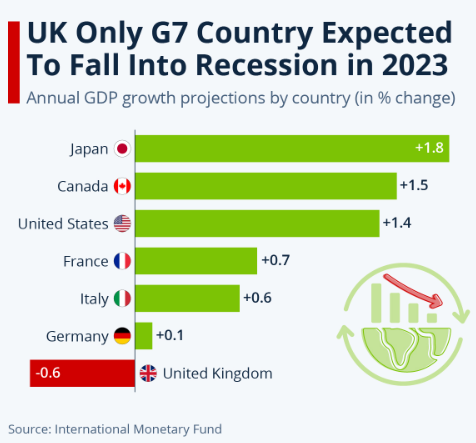
So much for the recession being widely anticipated. I think this ties up with the idea that a soft landing is now the consensus expectation.

-
I think it is bullish that markets no longer need to fight the Fed. Last year there was a feeling that the Fed was intentionally trying to suppress markets to tighten financial conditions deliberately escalating the hawkish tones after every bear market rally. Recent press release makes it clear they don't really care what happens to markets in the short term. However I do feel that at 4100 SPY markets are pricing in a strong probability of a soft landing. Not sure that confidence is quite warranted. Although in fairness the market correctly called the V shaped recovery from COVID while most economists were talking a depression.
-
The one thing that does worry me a little is that if disinflation is proceeding faster than expected and without the Fed having to take interest rates as high as they thought they would have to it could be a sign that the economy is slowing down rapidly and there is still the possibility of an overshoot and a hard landing. Also while a lot of the price increases have already gone through I don't think we are done with wage increases. Prices have increased by roughly 20% since the pandemic and most people haven't seen 20% pay increases over the same period. Wage bargaining is an annual event and with the money illusion it can take some time for people to realize their real wages have fallen and adjust their wage expectations accordingly. You just have to look at all the strikes in the UK with public sector workers demanding 20% pay increases. It would be easier to restrain wage inflation if unemployment was high and people were worried about losing their jobs. But the labour market remains pretty tight with labour shortages in many areas.
-
I think it is pretty clear now that the Fed has no real interest in suppressing stock prices to try and tighten financial conditions. Equities now have a free licence to melt up.
-
History sometimes rhymes. January 2001 also saw double digit NASDAQ returns. And a big factor in that move was the Fed cutting rates. Now 22 years on a big factor is the idea that the Fed is ready to pause.
-
Where Does the Global Economy Go From Here?
mattee2264 replied to Viking's topic in General Discussion
I think this could be how it turns out. So far the economy is holding up pretty well so it looks like we are getting disinflation and a soft landing which is incredibly bullish. But it could be that a hard landing has been postponed until later in 2023 or even early 2024. Also as the Fed is well aware you shouldn't count your chickens too soon when it comes to taming inflation and China coming back online will reverse commodity price disinflation and there are going to be a lot of wage increases coming through in January. Leading indicators are still very worrying and it is possible markets are being lulled into a false sense of security by the relatively soft historic data. -
If tech stocks get into value territory (i.e. 10x earnings etc) which happened with Microsoft about a decade ago and Apple several years ago and Facebook last year then there is definitely a lot of money to be made. But the mispricing usually occurs because they are under a cloud e.g. Microsoft's PC business was dying, Apple was thought to be at risk from cheaper smartphones, Facebook was losing out to Tik Tok and wasting tons of money on the metaverse. And there are contrary examples of famous and mature tech companies that got cheap and turned out to be value traps so it is not always as obvious and it can be with the benefits of hindsight. Also you have to put a 50% decline in the context of crazy high market caps and stock prices that have increased five to ten fold over the last decade or so. As for the relatively unblemished mega tech stocks like Microsoft, Apple, Google etc you still have the law of large numbers. Cloud growth and services growth is going to be a lot more subdued going forward and there is no guarantee new avenues for growth will be discovered. And when you combine slower growth with higher interest rates that can result in a considerable hit to valuation multiples. And while obviously even more money can be made picking through the rubble of the unseasoned tech stocks that exploded in value during the pandemic only to crash back to earth and identifying which companies are going to be long term successes. But isn't an easy game easy or else everyone would have bought Amazon, eBay, Priceline etc in 2002. Also during the pandemic mega tech stocks gained a reputation as a safe haven and now that the market is far less worried about aggressive rate hikes and starting to get a little more worried about a possible recession they may be reprising that role. Of course the shock might be that the mega tech stocks are more cyclical than people realize especially as they now represent a large part of the economy and are close to market saturation.
-
Wasn't Marko a super bull last year? Also read the Grantham article. I think he makes an interesting point about sentiment/confidence. Markets tend to be overvalued throughout bull markets and undervalued throughout bear markets and rarely trade at fair value. You can try and come up with reasons why confidence will decline. Obviously in 2022 it was central banks turning hawkish but those fears are fading. Historically recessions would have scared investors. But memories are short and the last few recessions we had were extreme and took investors by surprise. Perhaps because this one is so widely expected it is easy to look through it. It also appears that most people assume it will be mild as earnings estimates haven't changed markedly. And if confidence does not decline sufficiently then markets can go sideways for years until earnings catch up. I remember a few years back Grantham's fair value was 2500 now it is 3200 and perhaps by the time markets do fall back to fair value fair value will be 3800.
-
Not sure I completely buy the "inflation added 20% to nominal earnings" and therefore by implication justifies an extra 600-800 points on the SPY argument compared to pre-pandemic levels. We are already seeing some discounting and while firms were very proactive about increasing their prices early on taking advantage of pricing power and a relatively strong economy they are also going to find their costs go up and a lot of costs e.g.. wage costs show a lagged response to inflation. And willingness to pay higher prices is going to decline once layoffs start to hit and people adjust to higher prices by looking for cheaper alternatives or economizing and revenues are equal to price x quantity sold so if quantity sold starts to slide in a recession earnings will fall even if prices remain elevated.