Loss Horizon
-
Posts
77 -
Joined
-
Last visited
Content Type
Profiles
Forums
Events
Everything posted by Loss Horizon
-
You can read whatever you want in my posts
-
https://en.wikipedia.org/wiki/Privacy_concerns_with_Facebook https://en.wikipedia.org/wiki/Criticism_of_Facebook#Privacy_issues https://en.wikipedia.org/wiki/Facebook–Cambridge_Analytica_data_scandal https://www.businessinsider.com/well-these-new-zuckerberg-ims-wont-help-facebooks-privacy-problems-2010-5 And I agree with Zuck here on his assessment of his users.
-
That's fantastic development. The social media with short video, infinite feeds and algorithms optimized for "engagement" are definitely harmful. They fry brains.
-
Nobody handed the keys to the government yet, but Zuckerberg has been selling data for more than a decade. So far it's the US that is pioneering hostile controls so far, as Newsom signed the law to require an ID to use any operating system in California. That is truly ridiculous. And he is a possible candidate to become the next president.
-
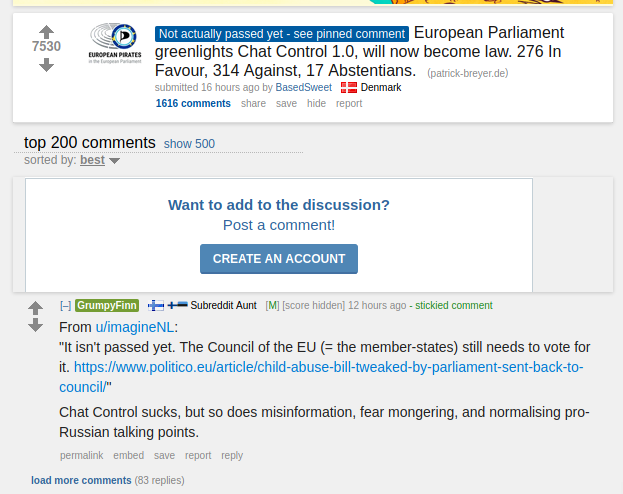
Check that Reddit thread again. I tried to find information about this proposal and the process, couldn't find anything in reputable sources, and there is no information about passing the law on the website of the Parliament. I don't think it's passed yet. In general I am concerned with privacy very much. But for me the Big Tech is much bigger threat than any government agency, because government has no clue about technology and Big Tech is extremely smart in abusing it. For chatting with my friends I have to use Whatsapp and Telegram. And I just have to accept that there is no privacy there, because I have zero trust in their developers. Facebook has a track record of selling private messages, and can probably sell to American Government. Durov has the same vibe and probably sells to Russian government. If I truly needed high secrecy of my communication, I would use an independent operating system and an independent encryption system with keys I can control. But messengers like that are not popular, and none of my friends use that. And again, I don't understand how this topic is an investment issue. China has Wechat and its economy is doing well: https://en.wikipedia.org/wiki/WeChat#State_surveillance_and_intelligence_gathering

-
That's just a technical possibility. As a developer of the operating system and the messenger which runs on it, having a system of over the air updates which the user doesn't control, they absolutely can do anything on the device without the user knowing anything about it. However Apple does have good reputation for privacy, so it's possible that they never abuse their unchecked power here. There was somewhat similar situation with Intel and their system of "Management Engine" in their CPUs. The cybersecurity community was concerned that the system could function as a backdoor: https://en.wikipedia.org/wiki/Intel_Management_Engine#Assertions_that_ME_is_a_backdoor . However after many years the fear didn't materialize, and it's clear that there was probably nothing like that. But the possibility is there and nobody could be sure. We can only rely on whistleblowers to prevent abuse of technology. Other companies like Facebook did abuse privacy and it is documented.
-
I'm sure Facebook will sell any private data to the highest bidder with no problem, as it did in the past. I don't see a reason for them to exclude government agencies from this business. https://en.wikipedia.org/wiki/Privacy_concerns_with_Facebook : Apple can certainly access your information, because they control the operating system on your smartphone via cloud, which has all your decryption keys. But it's good for the business of selling smartphones to publicly reject law enforcement requests.
-
Reddit is a similar echo-chamber, just with a different bias and better moderation. "Commission can just tweak the wording and propose it again while Parliament can only fight it" - that's an absurd wording. The Parliament is the gatekeeper, and any proposal must get their approval to get traction. They don't have to "fight", because if they do nothing then it won't be passed. People here somehow confuse and mix democracy and privacy. In this case I don't see any threat to democracy, but there is some threat to privacy. For example, in the US privacy is quite bad, but democracy is very strong (despite Trump's efforts). I still don't understand how this discussion is relevant to investing, because in China both democracy and privacy are weak, yet the economy is doing well currently.
-
Twitter people have no idea about democracy, as usual. To give a non-democratic example, numerous punitive laws in Russia are approved by the parliament in a few days, from initial idea to legal validity. Here we see 3 years of discussions and multiple rejections - that is as democratic as it gets. You could phrase this as "the EU is preventing chat control for the 6th time", because the EU consists of multiple actors, some o which are coming up with ideas, and some are rejecting or approving ideas. Compare this again with the Russian president who decided to start a full scale war without asking anyone. Or the American president who did the same recently.
-
Google, Facebook are built on collecting personal data, it's the whole business model. Every Big Tech today does that
-
Good article, I'm curious how it plays out. I agree that free market is a most powerful force, and have faith in Adam Smith's model. Uncompetitive companies must close or improve, and a crisis is often helpful to overcome long standing inefficiencies. Companies which are successful for too long become stagnant. The question is how predatory pricing and massive state intervention works out for a nation of 1 billion people. China has a good shot for long term success, but it hasn't won yet. The last empire with state control over economy and industry was Soviet Union, and it failed badly. China allows quite a lot of free market besides state control, so here is innovation. China does hostile moves not only against Germany and Europe, but also against USA, South Korea, Japan, Taiwan, Israel and others. Together those countries could easily organize and compete.
-
Now it is competition in honesty. And ... China is winning? Suppressing population is often successful, as it is shown by North Korea, Russia, and to great extent by modern China. It's only developed democracies that are vulnerable to exploitation by populists. Because they maintain political freedoms to do so. In aspiring dictatorships all opposition is destroyed early and one person or a small group controls all parts of society.
-
I'm also puzzled why this topic came up at all. China is doing better than Europe economically, and free speech there is much worse. No idea why it's in the focus in investor's discussion.
-
You are deeply mistaken to equate insulting and criticizing. You can criticize without insulting, and you can insult without criticizing. There are no laws against criticizing, there are laws against insulting.
-
In USSR/Russia, many people do love local censorship and live in peace with it. It's just never called "censorship". Many are thrown to jail for "terrorism", "extremism", being a "foreign agent", "mentally ill", which sounds just right for the majority. Most convictions for speech have zero public awareness, because the government controls 100% of mass media. And the same media love to discuss "censorship" in Europe, because everything is transparent in Europe. That's why "bad" Europe "doesn't have free speech".
-
Speech is conduct, which is obvious even in the US: https://en.wikipedia.org/wiki/United_States_free_speech_exceptions
-
I can see why populists in the West have such an easy time. People have it so good for so long that they forgot what really oppressive censorship looks like. It's same argument as the US has no freedom and no liberty because you can't drink beer from a bottle in public.
-
What exactly I'm missing? I just wrote a lot of text about that. I checked this: https://www.theguardian.com/world/2026/mar/26/finnish-mp-paivi-rasanen-convicted-homosexuality-developmental-disorder That's what I'm talking about. There is a long standing law in question, and "the US-based conservative legal advocacy group Alliance Defending Freedom, which has tried to use her case as an example of censorship in Europe" is upset about something happening in another country with different rules.
-
Nothing? In Germany, some people who say this are literally in the parliament. Btw, who promised free speech in the first place? In Germany it is clearly limited by federal laws. For example, insulting somebody is a crime, as it in the law for long time already. Quoting the Nazis is also a crime. Just don't do crime and get familiar with local laws before you enter a country. But the courts are quite relaxed, and they usually allow of some insults to politicians, because it's part of politicians' job to have a thick skin. When I visited the US, I had to prepare and learn many things: what to say to the border control, that if I'm stopped by road police I better keep my hands on the wheel and visible, that I must keep alcohol bottles in trunk when driving, and cover a bottle with a paper bag if drinking in public. That I must not say the Russian word "книга"("book") in public. Those feel ridiculous, but I accepted and prepared as a guest. Same with Germany. The American populists, including the current ruling class, love to compare rules like that with other countries and imply that it is something bad.
-
Yes
-
Yet EU's GDP is 2/3 of US GDP. US is clearly leading in market cap and hyper-growth startups. What's the comparison of Mittelstand?
-
Wise words. Again, I'm from Russia. My country is run by one guy and his friends for the last 25 years. All opposition is either dead, in prison, or in immigration. Every elections is fake. The country is in a pretty bad shape, my heart aches. Germany is not that. It is maybe the opposite. The elections are real, opposition is very much active, the politicians at the top are quite diverse in my opinion. People are so much more happy and content.
-
Politics of the region has very little to do with personality of Mrs von der Leyen. The mistake of shutting down nuclear energy in Germany was not made by a single person or a group, it was a result of many different developments. Multiple big politicians being involved with Russia(btw, members of your favorite AfD are openly close to Russia) and its energy industry, people scared of Chernobyl and Fukushima, apparent success of renewable energy, troubles with building storage for nuclear waste. I have a personal story about that. Russia imported a lot of nuclear waste from European countries for a fee. The material was transported on the same railroad as passengers, where I personally lived. Then it was dumped in a pit somewhere in Siberian forests. I saw the special railroad cars made of lead many times, they had 8 pairs of wheels, with some soldiers always around. Sometimes they were standing on a rail station next to a passenger train. Unlike other countries, Germany has never exported its nuclear waste, which is quite a responsible decision.
-
I'm curious, do you believe "outsiders" won't be promoting people who make mistakes? Do you believe that "promoting leaders who make mistakes" is an inherent feature of organization "European system" and doesn't happen in other organizations?
-
Fantastic analysis. I would add a global energy disruption: 20% of global oil and 20% or global LNG are blocked. It will hurt all energy importers, as the market is quite efficient. Europe doesn't import much of Qatari LNG, but its importers are not bound by anything, they can redirect shipments to higher paying Qatar's customers, so the global price is what matters. One short term hope is that China is affected and it could negotiate passing of its ships, which will relieve global prices somewhat. Another result is upcoming wider transformation of warfare. Hundreds millions $ worth of Tomahawks and decades of production capacity have been spent in an instant, with no decisive victory. While cheap Iranian drones are effective too.