djokovic1
-
Posts
256 -
Joined
-
Last visited
-
Days Won
3
Content Type
Profiles
Forums
Events
Everything posted by djokovic1
-
Ahh thanks @Junior R I get overexcited when I see buybacks announced. Sounds like it is re-instating the annual NCIB that was already in place. But my general points still stand
-
I think the announcement of the NCIB is pretty big news on how undervalued FFH management thinks their share price is relative to their earnings power. This allows them to be in the market daily as it's managed externally even if they are in blackout etc. To me it shows they feel their shares are very undervalued and they want to get their hands on as many as they can at these prices. Good debate / discussion with @petec and @Viking, it makes for a better board discussion! I personally see the current price as extremely cheap relative to earnings power (similar to Viking) and similar to FFH management. I think the capital allocation is structurally different today, the main change being the move away from hedging (amongst other things as Viking has pointed out). Structurally low interest rates would be my biggest concern (although I doubt we see a repeat of zero rates), which is why I would love to see them extend the duration of their book at current rates. Also @Hamburg Investor point of zooming out to a 20 year view is very useful, and then the macro considerations matter much less. They key question becomes do you trust their capital allocation and alignment. "Fairfax is making this NCIB because it believes that in appropriate circumstances its Subordinate Voting Shares and Preferred Shares represent an attractive investment opportunity and that, with respect to the Subordinate Voting Shares, purchases under the bid will enhance the value of the Subordinate Voting Shares held by the remaining shareholders." They other aspect that doesn't get talked about enough is that with the earnings they have locked in (the fixed income side) for the next 3 years, they will continue to grow sustainable EPS by buying more businesses (public and private), growing insurance premium and reducing share count. Which will compensate for lower interest rates if it does happen. So in my view the downside of earnings power going down meaningfully is low.
-
I have been quite surprised with FFH’s relative stock underperformance after blowing Q2 numbers out of the park. And looks to be similar for Q3 too give their equity holdings performance and no big cat. Nice to see mgmt taking advantage of that widening recent discrepancy between price and intrinsic value in August
-
@Viking this is another great piece of analysis thank you. and in the short to medium term something that is completely missed by sell side analysts and in my view the market. Because they assume reversion to the mean and worse still ignore the impact of compounding of great equity returns. You alluded to this but to drive home the point, most other insurers dont invest this way because they are not long term and dont have true alignment (or skill) at the top to invest an adequate amount in equities. The only ones who do it this way are Berkshire, Fairfax and Markel who have the alignment and incentives to take a long term view and not be worried about short term fluctuations. And as we have seen recently FFH >> Markel w.r.t investments and FFH > Berkshire due to its ability to invest smaller i.e the opportunity set is much larger.
-
Thanks! Makes sense.
-
Love this chart, thanks for sharing! Would it be correct to say, that in part the non insurance related growth and compounding (especially the last 4-5 years) has de-risked the cat risk. Berkshire would be an extreme example of this.
-
Does someone have an understanding if Tariffs affect Fairfax’s insurance operations? I am ignorant on this aspect.
-
@Viking thanks as usual for your detailed analysis. I have ~$200/ share (diluted) for 2025 and ~ ~$195/share for 2026. There are 2 main differences in our assumptions: i) I have higher gain on investments for 2H 2025 and 2026. It looks like your assumptions for 2H 2025 and 2026 are a bit below the long term average of their aggregate investment returns of 7.7% which all else equal should be achievable with the locked in 5.1% fixed income yields and FFH undervaluation (TRS). Of course in the short term it is impossible to forecast with precision and is a fools errand and is dependent on what FFH stock price does (amongst a lot of other variables). ii) What do you assume they do with significant ROE (~15%+ so far) / net income they generate in 2025. In general that additional cash should simplistically either lead to a significant (~10%) reduction in share count (if all deployed in buybacks at <10x earnings) or lead to a 15% larger investment portfolio (ie higher interest income, profit from associates and all else equal higher investment gains) or deploy into M&A which again means higher underwriting profit and investment income. Of course in reality it will be a mix of all and likely organic premium growth will be muted with the softer market but it seems like you dont have that assumption in there going from 2025 to 2026.
-
@SafetyinNumbers Yes thats a good point re. a) low passive ownership and b) investing in stuff that most quality investors would pass on (although that is somewhat correlated to not trusting their capital allocation possibly influenced by the 2010-2020 period). More passive ownership as you have alluded to is also a question of when not if. Regardless, the obvious good news is while it remains undervalued, the more chance for FFH to create value through buybacks/TRS.
-
I don't think complexity is the issue. From an analysis perspective its no different from a Berkshire or Markel. I am pretty certain because of the 2010-2020 period lot of investors have written of Fairfax / Prem as a bad capital allocator without going into the details. I was guilty of this too initially. I have seen this come up multiple times as a reason investors haven't dug into Fairfax when I have mentioned it to them recently. That perception will inevitably change over time as long as the stellar execution continues. It already has a decent bit from 2020 but intrinsic value has also grown significantly since then.
-
Yes this is where I am coming from too. Extending duration at these interest rates, i.e locking in a (5%*3) 15% ROE through fixed income seems like a good risk reward to me. I concur with others that I don't mind the sell down of the 30 year as if rates rise those bonds will get affected the most. I guess we will see the direction of travel in Q3. Maybe a question for the next conference call, to understand how they think about this.
-
I am surprised and a little disappointed they have taken down duration. The US 5 & 10 year is close to 20 year highs and the absolute interest rate levels generate very healthy ROE's for them given the 3:1 leverage. My intuition is it's still a good time to keep extending the duration at these absolute interest rate levels.
-
Consolidated interest and dividend income increased to $666m for the quarter (up 10% YoY). This is the stable sticky fixed income yield (for ~4 years), which on an annualized basis is ~$125/share. The underwriting profit of $425m annualized is $80/share. So the rough napkin math has the annualized earnings power before equity investments = $125 + $80 = ~$200 / share. With a stock price of US$ 1,770 that is a multiple of $1770/$200 = 9x on a repeatable earnings base before accounting for any earnings from equity investments and on the other side interest and central costs. Of course underwriting profits will vary YoY but they have now shown a track record of consistent profitability. Further, fixed income earnings power and underwriting earnings power will keep growing YoY by ~15-20% as the ROE is reinvested into growth, buybacks and M&A.
-
I agree @Viking They are in the best position to assess the intrinsic value of Fairfax and clearly their actions seem to indicate it remains significantly undervalued given the rise in intrinsic value. Separately, if someone feels that Fairfax is fairly valued today and they shouldn’t hold the TRS, then arguably that investor should also not hold Fairfax stock. (I get that TRS is excess leverage so should demand additional margin of safety) also great quarter as you had predicted!
-
The combination of getting paid to invest float (i.e good underwriting) and having the ability to invest it wisely is a superpower. As far as I know, very few insurance companies take on the responsibility to invest themselves (especially the non fixed income side). The few that do it, have had tremendous compounding. Berkshire, Fairfax, Markel (despite recent challenges, long term is great). And maybe a new one for some on this board, Protector from Sweden.
-
@Viking Thanks for your great analysis as always. I completely agree, that prudent use of leverage can significantly improve ROE and shareholder returns. And exactly on that topic, Fairfax has 3:1 leverage, Markel ~2:1 leverage and Berkshire ~1:1 leverage (although Markel and especially Berkshire have a much higher equities (higher expected return) proportion in their book). All else equal, the Fairfax model should outperform Markel and Berkshire due to the higher investment leverage when interest rates are meaningfully high as they are now. The benefit decreases at lower interest rates.
-
Completely agree! And to be honest, I struggled with this same problem i.e I likely would not invest in Orla mining or Eurobank directly. But also to be honest, partly for the wrong reasons -> a) I don't know the people running it at all and b) I deem it outside my circle of competence without doing more work. But arguably, solvable problems. I think one of the big elements that explains FFH's success is partnering with driven aligned great capital allocators across different industries. This strategy is very similar to Berkshire and works perfectly in the decentralised approach.
-
No I don't dispute that. But my argument is that the assessment that has to be made is that -> do I have the ability to assess if Prem Watsa and team are great investors. And it's fair enough for an investor to feel, that is outside their circle of competence. The point I was trying to make is that, I have heard a few investors reject Fairfax because they dont like the underlying equity investments because they are usually different from high quality compounders / because they are not investments they could stomach themselves. And I disagree with the simplistic rejection of Fairfax on that basis.
-
@MMM20 @Charlie My view is that for FFH it is not a question of circle of competence. The 'simple' question an investor has to answer is: Do you trust Prem and his investment team's capital allocation abilities over the next decades? In my view there is a 40 year track record to help answer that question. PS: It seems to run in the family, his son has compounded at 29% net (5 years) h/t @SafetyinNumbers
-
I have a different take than yours on this. After getting a huge payoff on the CDS trades during GFC, I think Prem may have concluded there is benefit (and an ability?) to make significant macro calls. His view through the hedging period was the markets were overvalued. Prem was market timing and making a significant macro call on the direction of equity markets. 2010 letter "Our view was twofold: our capital had benefitted greatly from our common stock portfolio and we wanted to protect our gains, and we worried about the unintended consequences of too much debt in the system – worldwide! " 2012 letter: "We are comfortable maintaining our hedges because of all the uncertainties we see in front of us..." 2015 letter: "Hedging our equity exposure has been very costly for us. .....However, ....we see a great disconnect between the market and economic fundamentals" Throughout this period he made a macro call that equity markets were overvalued, which was very costly for shareholders. My personal view is that long term equity investing and hedging don't go together. To be clear, to manage Fairfax's bond portfolio there will always be a macro element to it -> which they did beautifully by lessening duration in 2021 but hedging the equity book is an exercise in futility.
-
No hedging is a bad idea. Doesn’t work with long term investing. One of the reasons a lot of investors dismiss Fairfax today is not understanding that the lost decade was in a large part due to hedging which will not happen again.
-
@MMM20 I am much more optimistic. With rough assumptions you can confidently get to a 15-20% ROE for the next 4 years, especially with 5% rates locked in. Downside is low. The equity portfolio (+TRS) may create volatility any one year but if you zoom out 3-4 years, it will create a lot of compounding value. I personally also prefer Prem's equity positioning which has a value bent rather than a high multiple 'quality' bent. Additionally, the FFH compounding package is below 9x earnings and well below peer multiples, so you can take it as a margin of safety or potential for significant multiple expansion (20x would still be considered cheap by a lot of investors for a 15-20% compounder). I personally use a normalised combined ratio of 95% rather than 100% but the CR is not the big driver of ROE, investment returns are. The biggest risk is pro-longed low rates which would make the normalized earnings power lower (but lot of moving parts, and their current earnings will be reinvested to compound in the meantime). And at the current multiple, its a risk I am very comfortable to take.
-
Yes for me this is the main point, i.e we are trading below 10x sustainable earnings. Also this $150/share is understated because: i) Each year this $150/share will be re-invested into buybacks and premium growth which will grow the $150/share by roughly 15% each year. ii) Equity returns which are not included can have a meaningful impact over long time frames
-
Thanks @Viking and completely agreed. That’s why I expect 15-20 % EPS compounding and not just 15% over the next few years.
-
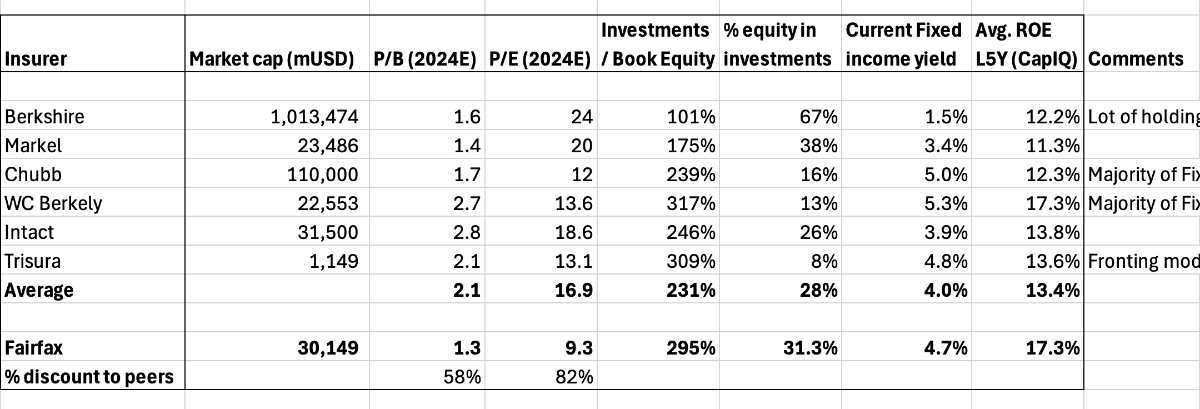
It's good to be a harsh critic of your investments but as a new (2025) investor in Fairfax this would be my riposte: 1) I see 15-20% close to locked in EPS / book value compounding for the next 4 years. You get that at 10x earnings. Hard to find something this attractive with very low risk currently (if someone has something better please let me know!, I am all ears). 2) Fairfax even after this huge run-up is hugely mispriced. Take a look at this table I created a few weeks ago, Note all numbers from CapitalIQ. And table was created before Fairfax earnings. They have the best 5 year track record (ROE) but are trading at a significant discount to peers. Gives a nice margin of safety and potential for multiple expansion. For me the biggest longterm risk > 5 years out is if we go to a very low rate environment again