dartmonkey
-
Posts
642 -
Joined
-
Last visited
-
Days Won
3
Content Type
Profiles
Forums
Events
Everything posted by dartmonkey
-
Roughly transcribed: "So it has the utility, to us, of common equity, in terms of what we can do with it. How you value that, in terms of intrinsic value, is up to you." I agree that the 1:1 equivalence with cash would be the upper bound. On the other hand, the value of the insurance business that generates that float could be more than the value of the float, if it has negative cost (i.e. positive underwriting profit, on average.)
-
Buffett, AR 2018: "Beyond using debt and equity, Berkshire has benefitted in a major way from two less-common sources of corporate funding. The larger is the float I have described. So far, those funds, though they are recorded as a huge net liability on our balance sheet, have been of more utility to us than an equivalent amount of equity. That’s because they have usually been accompanied by underwriting earnings. In effect, we have been paid in most years for holding and using other people’s money." So the float is more valuable than equity if it produces underwriting gains, which of course is typical both of Berkshire and Fairfax.
-
Minor quibble: float that is not going to disappear may be worth almost as much as its equivalent in cash, but surely never more. If you are FFH and you have $35.1b in float (end of 2023 number) and can invest that float for a good return, it may be worth close to $35.1b in cash, which you might add to its book value, $21.6b, to get $56.7b, divided by 22,891,108 shares outstanding, to get $2477 per share. Updated to Q3, if we still had $35.1b in float (I don't think they report the updated value every quarter), and $22.7b in equity, divided by 21,990,603 shares outstanding, we would get $2628 per share, close to your figure, and even closer if you model in the probable increase in float over 3 quarters which you may have done here. But if Fairfax could magically just keep that $35.1b in funds in perpetuity, with all the concomitant obligations to insured parties waived, that would be even better, right? In other words, a $1m 0% interest loan that is due in 40 years is great, and it's probably worth almost $1m, but certainly not more than $1m. I imagine you might say that it is worth more than $1m if the loan amount keeps increasing over time, but if Fairfax's float is increasing, it is because Fairfax is investing some of its earnings in buying new insurance businesses, or putting new capital into existing businesses, so there would be some double counting there. The other thing that makes float worth a little less than its equivalent in cash, is that, being insurance float, there are some restrictions placed on what that cash can be invested in, meaning it has to be mostly invested in safe bonds. Anyways, by that method #3 metric, it would mean that (22.7+35.1)/22.7= 2.55 would be a P:B ratio that would make FFH fully valued. High enough that we don't have to worry too much about the details, and from today's 1.42 we have lots of room to grow before we get there. And if we get to 2.5, we could alwaysswitch to Method #1
-
Why would a rational seller accept totally overpriced shares for their company? Only a fool or a BS artist would, and I am not sure that's the type of company FFH would want to buy. It doesn't have to be shares for shares. FFH could perfectly well issue shares and use the cash for an acquisition. If the timing makes it awkward to issue shares, they could even sell swaps, or sell the ones they already have. The point is that they would have access to more liquidity.
-
I didn't know this. How would we know, has Watsa ever mentioned that? Watsa would certainly seem to have a big advantage on Buffett, when it comes to feeling comfortable with an insurance business in India and its management.
-
In the hopes of preventing a nasty scuffle breaking out, let me just say that I appreciate both sides of this argument. If FFH were to go to 4x book, I would be selling most of my shares, just because there would be no margin of safety and a high risk of a drawdown. But I would probably still keep some, because I would be quite confident that Fairfax would be able to use those high prices to increase value for ongoing shareholders, by ALSO selling shares but using that cash to invest in assets with a reasonable return. I think having a high P:B ratio would be unarguably good for Fairfax, because of this latter opportunity. It would also be very good for my portfolio, and I would be happy to sell 3/4 of my holdings and lock in that return. The only 2 downsides I can see, is that it would obviously not be good for Fairfax repurchasing shares and keeping the company small - no one should want it to go to $1 trillion like Berkshire. And if Fairfax were to go on to make great returns over the subsequent 10 years, at very high prices, being at 4x would have dumped me out of most of my position, so I wouldn't get all that upside. But if I can get $4000 US per share today, a bird in hand would have compensated me very well for having missed out on x birds in the bush.
-
I think both views expressed above can be reconciled by differentiating between the short term and the long term. In the short term, the market is a voting machine, and that vote is expressed by supply and demand, with a new demand (like indexers buying 4% of outstanding shares) likely to push the price up. This could be an important consideration for someone who wants to buy new shares or trade around a position. In the long term, the market is a weighing machine, and what counts is primarily sustainable earnings, and secondarily, asset values anchoring the value. If Fairfax continues earning 15% on equity for another 10 years, its price will be about 4 times today's price, and whether or not FFH is in the TSX 60 will be completely irrelevant to that. The focus of long term investors should be on earnings, on new investments and how likely they are to produce future earnings. For a long-term investor, inclusion in the TSX 60 and a subsequent share price increase also has 2 furthert small advantages, IMO: (i) it makes liquidity less of an issue, since FFH adds the option of issuing shares, for instance if they wanted to buy a big Indian bank or reaquire assets from OMERS; (ii) it reinforces Fairfax's visibility and credibility, in Canada and overseas, when it wants to do a big transaction. Admittedly, the lack of inclusion does not seem to be hampering Fairfax at the moment, but index inclusion would just be one more sign that the dark ages of the tech shorts, the Blackberry position, the macro bet on deflation, etc. are behind us and that the new Fairfax is concentrated on insurance and solid investments of the insurance float in sensible businesses.
-
Above what you had actually said on the main Fairfax topic. Below what is easy to monkey around after looking the result. True, I initially guessed 5% off, on Dec. 2, a week ago ($100), but then on Dec. 6, Friday (at 8:07 PM), I guessed $50. It's off $42 right now, although it got as low as $80 off, so I guess I will go with my Friday pick But it was before looking at the result, which we only got this morning.
-
That's what I would have said, too. I guessed $50 down today, about 2.5%, and I wouldn't be surprised if that's the lowest it goes. Not enough for me to buy any more, if that turns out to be correct. Of course, the whole market is at nosebleed prices, so if there's a general downturn, FFH will not be exempt. When will the inclusion happen? If FFH being #25 in the list of Canadian companies by market cap is not enough to bump the #112, Algonquin, I can't see why being say #22, if they pass the 3 financials in front of them, would make much of a difference. If they just wait until one of the TSX 60 is bought out, the wait may be a lot longer than next March. So an interesting question might be, what will FFH's rank be when it finally gets included? If FFH's price just follows its growth in book value about 15% every year for the next few years just from earnings accumulation, and if the inclusion happened iin 3 years, it might be up to about #19-20, assuming no major changes in the companies between #24 and #20 (National Bank, Intact, Sun Life, Imperial Oil, Loblaws)...
-
In previous announcements, when there have been changes both to the Composite and the 60, they have announced both at the same time. So it is safe to conclude that there are no changes to the 60. Now it will be interesting to see if FFH shares drop on Monday. If they do, it will be because some were expecting a bump on the expected inclusion. My guess is we see a $50 drop on Monday. Of course, it doesn't really matter, as others have said, since (a) it will allow for more buybacks and (b) it's just postponing the inevitable. But I tend to agree with those who think a high share price would be / will be a good thing. At current prices that are much higher than a year ago, buybacks are still probably value-enhancing, but they're not the slam dunk they were. And a high price would allow them more flexibility in how they finance things like the anticipated Indian bank acquisition or buying back stakes of companies they have parked with OMERS. In fact, the ideal would be a run-up to 3x book for a while, so they could issue a bunch of shares and reduce their leverage. Or even better, 3x book next year, issue shares, then plunge back to 1x book, buy those shares back, rinse, repeat. The Henry Singleton technique.
-
Looks like there has been no addition: In past additions to the TSX 60, they say something like this:

-
I love it when someone has actually looked into this fine level of detail! But yes, it seems the write 5:15 PM on all their press releases, and maybe sometimes something comes up that means it only gets out a few minutes later. https://www.spglobal.com/spdji/en/indices/equity/sp-tsx-60-index/#news-research While we're waiting, who wants to opine on the probability of inclusion? I say 60%. There's no wrong answer, but I'm curious what others think.
-
Thanks for the links. Siemens AG owns Siemens Project Ventures GmbH (SPV), as nwoodman noted, and SPV, "as part of Siemens Financial Services, operates within a defined strategic framework set by Siemens AG. Its primary role is to invest in infrastructure and energy projects that align with the parent company’s long-term objectives." I don't know why an airport no longer fits the parents' long-term investments, because Siemens certainly is involved with airport logistics (https://www.siemens-logistics.com/en/airport-logistics). But they have held the Bangalore stake since 2001 (Siemens team wins bid to build international airport in Bangalore -(https://web.archive.org/web/20121024213153/http://www.rediff.com/money/2001/nov/01siemen.htm) so after 24+ years, maybe they have just had enough. In 2001, they had 74%, and the two government entities each owned 13%. Now the full 74% stake that Siemens owned originally has been transferred from Siemens to Fairfax (minus the OMERS stake, which they may have some arrangement for taking back some day), 20% of it directly from Siemens this year and last, and the rest from others that Siemens had sold stakes to, GVK and the Zurich Airport authority and perhaps someone else I am forgetting.
-
Yes, interesting that they sold 10% last year for $250m and a year later they're selling their last 10% for $255m in 3 payments (at close, August 2025 and July 2026), so in effect, selling for less. Hopefully this is because they are refocusing, and not because the airport is actually worth less. Siemens originally had 40%, and had sold 14% to GVK in 2011, before FIH existed, at a valuation of about $1b. A recap of FIH's ownership March 2017 - 38% for $385m (valuation $1b), 33% of which was from GVK (the other 5% from an unnamed seller, maybe Siemens?) https://www.fairfaxindia.ca/press-releases/fairfax-india-and-fairfax-to-acquire-33-of-the-equity-of-bangalore-international-airport-limited-2016-03-28/ July 2017 - 10% for $200m (valuation $2b), also from GVK (their remaining stake), with the price tag justified by FIH because it gave them a controlling stake, 48% (2017 annual report) May 2018 - 6% for $67m (valuation back to $1b) from Siemens, taking Siemens down to 20%, and putting FIH at 54% https://www.fairfaxindia.ca/press-releases/fairfax-india-acquires-an-additional-6-interest-in-bangalore-international-airport-limited-2018-05-16/ September 2021 - FIH sold 5% to OMERS, valuation $2.6b, so we can conclude that they got about $130m for this; they still 'control' 54% but only 'own' 49% https://www.fairfaxindia.ca/press-releases/fairfax-india-completes-sale-of-minority-position-of-anchorage-infrastructure-2021-09-16/ (they say that after this transaction, "Fairfax India’s effective ownership interest in BIAL decreased to approximately 49.0% on a fully-diluted basis, while its actual ownership remained unchanged." June and December 2023 - FIH bought another 10% from Siemens, in 2 tranches, for $250m (valuation $2.5b), so FIH controls 64% and owns 59% https://www.fairfaxindia.ca/press-releases/fairfax-india-completes-acquisition-of-an-additional-7-interest-in-bangalore-international-airport-limited-2023-12-12/ December 2024 - buys Siemens last 10%, $255m but in instalments, valuation a bit less than $2.5b, now control 74% and own 69% https://www.fairfaxindia.ca/press-releases/fairfax-india-to-acquire-an-additional-10-interest-in-bangalore-international-airport-limited-2024-12-03/ So with the exception of the control transaction at a higher price, we can say that the value attributed by management to the airport has gone fromo about $1b, 7 years ago, to $2.5b now. When they explain how it is valued, they say (AR, 2023) that "BIAL is carried on our books at 9.5 times normalized free cash flow, which we consider to be conservative." And in the 2023 Q3 report, they give more detail: "At September 30, 2024 the company estimated the fair value of its investment in BIAL using a discounted cash flow analysis for its four business units based on multi-year free cash flow forecasts with assumed after-tax discount rates ranging from 12.5% to 16.9% and a long term growth rate of 3.5% (December 31, 2023 - 12.4% to 16.9%, and 3.5%, respectively for three business units). At September 30, 2024 free cash flow forecasts were based on EBITDA estimates derived from financial information prepared in the third quarter of 2024 (December 31, 2023 - second quarter of 2023 and fourth quarter of 2022) by BIAL's management." Those are pretty high discount rates - that should mean that the $2.5b valuation we got on this latest 10% is a very good price. But it is a bit hard to see wht has not changed since September 2021, if the story is playing out as we hoped. If the discounted future free cash flow is worth the same now as it was 3 years ago, then that would imply that there has been no growth for the last 3 years, right?
-
Probably, although it is starting to fade into distant history. Here's a good analysis from 10 years ago that I think summarizes the situation well. Hempton is smart, refreshing, brave, and probably really believed that Fairfax was a good short. He also participated in some pretty unsavoury behaviour that means most people on this board will never forgive him. There's a bit of both, best to keep an open mind I'd say.
-
To think that Ackman going on TV and worrying about COVID might have been influencing the price of credit hedges and hotel stocks seems highly implausible - Ackman was far from alone in thinking that, and he does seem to have been worried enough to buy a shitload of protection, so he got that right. To make the case that he was worrying in public at exactly the same time while his traders were trading the opposite way presumes to know more about the timing of his comments and the trades than we really know. But the narrative here : https://www.cnbc.com/2020/03/27/bill-ackman-says-his-cnbc-interview-was-bullish-denies-harming-market.html suggests to me that his concern was genuine, and on the same day that he made his comments on CNBC, he also said that he was buying stocks, because he was confident that the situation could be brought under control. So I think he was advocating for draconian measures to combat COVID, not to push down the share values of the stocks he wanted to invest in, but in order to limit the damage to the shares he had already bought. Now I think Ackman has been proved totally wrong about COVID and its impact on the US: in retrospect, the whole shutdown was almost completely pointless. And you are right that the Allergan investment and attempts to shop it to Valeant were close to the line and resulted in SEC fines, although this seems to me to be pretty much activist investing 101: buy a stake and try to get it sold for a better price.
-
It's worth pointing out that the US$337m of the 'Rest of FIH (RoF)' is to be compared to the public equity stake of $1.1b and the private, non-BIAL stake of $0.7b. If a $2.55b valuation for BIAL is anything like a sane estimate, the RoF is being valued at about 20c on the dollar. Or alternatively, if the assessment of the RoF assets is right, it means the airport is only worth $1.95b, and they just bought another 10% at a valuation of $2.55b. Just goes to show what we knew already, is that FIH is really just about the airport, for the moment.
-
I appreciate the correction (completely forgot the OMERS piece, clearly). That changes the math. It reduces the 74% to 68.97%, which changes FFI's share of BIAL to be worth US$1.759B resulting in the rest of FFI to be valued at US$337M based on the share price mid-day. This seems to be correct, and corresponds to the statement in the Q3 report: At September 30, 2024 the company held 43.6% out of its 64.0% (December 31, 2023 - 43.6% out of its 64.0%) equity interest in BIAL through Anchorage. As a result, the company's fully-diluted equity interest in BIAL was 59.0% (December 31, 2023 - 59.0%). Refer to note 8 (Total Equity, under the heading Non-controlling interests) for further discussion on Anchorage. However, it is hard to understand why Fairfax India would issue a press release saying its ownership is going from 64% to 74%, with this transaction: Fairfax India’s equity interest in BIAL will increase from 64% to 74% (30.4% to be held by its wholly-owned subsidiary and 43.6% to continue to be held by its subsidiary, Anchorage Infrastructure Investments Holdings Limited). is is standard to say that you have a 64% equity interest in BIAL (going to 74%), when OMERS has a 5% interest? Clearly, that is the situation, because we know that OMERS has 11.5% of Anchorage, and Anchorage has 43.6% of BIAL, so that means OMERS has 11.5%*43.6% = 5.014% of BIAL. The PR also mentions that 2 Indian state entities, Airports Authority of India and Karnataka State Industrial and Infrastructure Development Corporation Limited, will continue to own 13% each, i.e. 26%, so Fairfax owns the rest, with OMERS having 11.5% of Anchorage, i.e. 4.98% of BIAL, leaving Fairfax with the rest, 100-13-13-5.014=68.986%. (Right? you say 68.97%, there must be a tiny error somewhere.)
-
If my memory serves me, Bill has taken positions (long as well as short) and then went on media and road shows trying to drum up support for his positio Well, he is selling his mutual fund, so it would make sense for him to talk about his purchases and how (insanely) successful they have been. But the accusation was that Ackman might be like Citron, and the fact that “By using the Citron Twitter Account to generate ‘catalysts’ — events with the ability to move stock prices — defendant Left profited from his advance knowledge that he was about to trigger such movements in the market.” Ackman has never done anything like this, to my knowledge, talking about a long or short investment while simultaneously trading it in the opposite direction. Ackman comes up for a lot of criticism nowadays, for his heresy of not supporting the right candidate, but this accusation seems gratuitous.
-
Like which ones, for instance? Ackman holds his positions for years, typically. He is about as far from “pump and dump“ as it is possible to get.
-
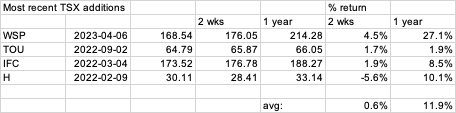
Ok, I used their press release to find the last 4 additions to the TSX60: I did this quickly, but it seems to show that the short-term movement has not been dramatic, in the first 2 weeks, and the one-year average movement has not been exceptional either, in the context of a bull market, probably beneath the average market performance over the same time period. Of course, that may be because the market had been pricing in the price change already. Based on this, we shouldn't expect any dramatic movements next Monday, if they decide to add FFH to the index.
-
No, neither did I, although the study I linked to showed not much effect for the S&P. I once had a link to the S&P website that listed the most recent inclusions into the TSX60, so it would be interesting to see what happened to, say, the last 10 additions, but I can't find that link for the moment. I can't even find the thread where we discussed all this about a year ago, maybe it will ring a bell and someone else can point it out.
-
Quibble: the announcement would come that day, but the addition of FFH, if it happens, would only come 2 weeks later. As for the impact on FFH's share price, it is likely to increase the price immediately following the announcement, although market participants are probably including some oor all of this increase in the price - it is far from a secret. This study showed that stocks added to the S&P 500 used to have a big rise, around 8% between announcement and inclusion, but only a trivial rise in the last 10 years: https://finance.yahoo.com/news/history-says-being-added-p-083500408.html. I don't know whether we have any such data for S&P TSX 60 stocks. But if we hear on Friday that FFH will be included, my bet would be there is less than a 5% move upwards in the following 2 weeks. And if FFH is not included, I bet we get a drop of at least 5%. That might be a good chance to buy before the next announcement.
-
It's a good sign when an all-time high close on both US and Canadian exchanges ($1414.98 and C$1986.30, respectively) hardly merits mentioning. The previous high for FRFHF, $1414, was a week ago (not mentioned here), and the previous highs for FFH were all three of the last 3 days; today's was the 4th day in a row, and there have been new highs 6 of the last 7 trading days. No doubt helped along by the collapse of the Canadian dollar. Maybe the market is expecting an announcement in a week, about inclusion in the S&P TSX 60?
-
Is Fairfax restricted from buying more? The price has gone up nicely, but not spectacularly; €2 now, and they were in a range between €0.50-1.00 seven or eight years ago, when they looked like they might not survive. between ). With earnings steady at about €0.36, they are at about 6 times earnings. Fairfax only owns 32.9%, couldn't they go a little higher, or do they have a standstill agreement with Eurobank or with the Greek regulators?