vinod1
-
Posts
1,765 -
Joined
-
Last visited
-
Days Won
7
Content Type
Profiles
Forums
Events
Everything posted by vinod1
-
From meetings etc. I think that's about right. He's well aware the world might muddle through. He just wants to make 100% sure that Fairfax survives if it does not. I dont think the implications of a great depression scenario have been thought through by Prem, or the posters here. Fairfax would not survive a great depression on the scale of the 1930s - It simply wouldn't. Blackberry would cease to exist in days, the entire restaurant business would collapse, the Greek Banks would shut, insurance sales would stop... most of the insurance business would close. The least of his problems would be collecting on his negative bets. All of the money, if it could be collected, would be eaten up to pay back the float due to shrinking premiums. Never mind the civil disruption, violence etc - The property/casualty business would be sunk under massive, continuous claims. This would not be a gentle, civil 1930s depression - the world has changed and gotten more crowded. Prem keeps stating that governments have used up their ammunition to fight another financial crisis/recession. I disagree. Governments, excepting China and India, have done very little infrastructure spending, above the normal run rate. Much of the world could easily ramp this up to fend off a great depression. All they have to do is print money - in a deflation that should not be a problem. The US could have done it in 2009, but for the gridlock in congress. It was easier to let the fed lead the way. FiNally, and perhaps most telling is that FFH keeps on investing in its future. Prem hasn't even skipped a beat. This is contrary to the way the press gloms onto the negative bets. He is not a pessimistic as everyone thinks by the way the letter reads. Look at the actions of FFH. Not a month goes by without an announcement of another aquisition or deal. +1 That makes a lot of sense. Vinod
-
Yeah, as the contracts are marked to market each quarter, collateral is passed from one party to the other. There are many ways to mark (to model) the contracts, and I'm sure any bank selling these would value them more conservatively than Fairfax if times get rough so as to post as little collateral as reasonable (without being called out for having a lack of collateral to post...), but with each measurement period, the bank would have to post collateral to back the net change to Fairfax if the contracts start moving in Fairfax's favor. Certainly, a 40% deflation like the GD would be a long drawn out affair, but the valuation change in contracts like these would move slowly each quarter to suck collateral in from the IB to Fairfax. A 1 quarter valuation change + the difference in valuation methodology would be the only thing at risk even if Fairfax held the contracts for massive gains over 5 years (as an example only). Hope that helps. Thanks! That is how I was thinking too although I did not factor in the valuation methodology. Vinod
-
These are collateralized contracts, so unless Citi goes under in one quarter, it seems nearly certain, they will in fact collect. Not defending the position itself, only the mechanics of posting collateral on a derivative contract... I would ascribe minute risk, and only to the last quarterly portion of value accrual. Good point. I did not realize that. I would think that the gains would not really show up in one quarter. Deflation would be a long drawn out process so the gains would have be to realized over many years. Again I could be wrong. Vinod
-
The implication seems to be that you had to wait 25 years to break even! But adjusting for dividends and inflation, it only took 7 years for investors to break even!! The dividend yield at the stock market bottom in 1933 was close to 14% !!! http://www.nytimes.com/2009/04/26/your-money/stocks-and-bonds/26stra.html?_r=0 !!!! A better measure of market performance would be from Shiller data or even simulated S&P 500 numbers, since Dow is not a good representation of the market and it was unduly impacted by its decision in the late 1930's to drop IBM from its index! Thank you! Vinod! Vinod! There is a problem with thinking people can just sit through a downturn. In the 1930s many people lost their jobs and had to liquidate all investments just to pay mortgage and groceries! Even successful professionals like doctors/lawyers that didn't lose their jobs, couldn't collect their receivables because all of their customers were broke. There was simply no money around! But they still had to pay their overhead. "The Great Depression: a Diary" by Benjamin Roth is a great insight into this (it has one or two entries per week). He was a lawyer living in a steel town and his town may have been worse off than some places. He continuously complains "if only he had a few spare dollars to invest" and how cheaply priced the stocks are. He barely had a spare nickel. My point is: if we do see a repeat of the Great Depression some day I think just about everyone will be surprised at how bad things can get! :-\ I agree with pretty much everything you said. I did read that book. If we do get another GD, I doubt if Fairfax would be able to collect its gains on deflation hedges. My point is, reading Prem Watsa's letters, I get the feeling that the likelihood of another GD is something of order of 20% or 30% or something like that. He never mentioned the probabilities, but just reading between the lines that is what I would infer - maybe not the right interpretation. I think the odds are an order of magnitude lower. Vinod
-
Over those 25 years (using year-end dates not peak), your annualized return was 7%! Do you have the dataset for this? I find this quite useful http://dqydj.net/sp-500-return-calculator/ Vinod
-
The implication seems to be that you had to wait 25 years to break even! But adjusting for dividends and inflation, it only took 7 years for investors to break even!! The dividend yield at the stock market bottom in 1933 was close to 14% !!! http://www.nytimes.com/2009/04/26/your-money/stocks-and-bonds/26stra.html?_r=0 !!!! A better measure of market performance would be from Shiller data or even simulated S&P 500 numbers, since Dow is not a good representation of the market and it was unduly impacted by its decision in the late 1930's to drop IBM from its index! Thank you! Vinod!
-
I think when we are talking about negative interest rates, we are talking about negative rates on sovereign debt, not on consumer or commercial debt. There is a credit premium as well that would make interest rates positive for non-sovereign debt. So credit card debt, mortgage debt, auto, vast majority of the commercial lending are going to be at positive interest rates. Interest rates are negative real rates for some of sovereign debt for a long time. So I do not see what the fuss is all about going a bit deeper into negative territory. Wealthy landlords used to keep their gold at goldsmiths and pay them for safe keeping. So negative rates on deposits is just going back to basics :) Negative rates if they do push down all other rates even more lower (assuming they stay that way for a very long time) should support much higher equity valuations. So even though cash flows are going to be lower in an environment of weak growth and very low interest rates, equity valuations can rationally be much higher due to lower discount rate. Vinod
-
Chou Opportunity Fund (CHOEX) to return fees
vinod1 replied to mhdousa's topic in General Discussion
I dont think you have met Amazon or Facebook investors. :) Vinod -
Remind us what it's like in a deep bear market when
vinod1 replied to LongHaul's topic in General Discussion
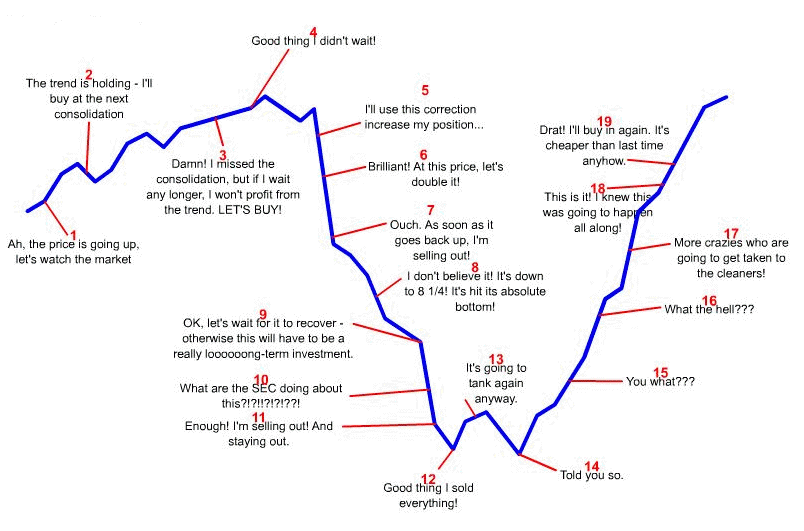
Do you have concrete examples of this or are we talking completely abstractly? Without examples, my reaction is that it might be obvious to you what x is, but it is not necessarily obvious to everyone and especially not necessarily at the time when stock is bought or sold. Assuming that x is obvious, people would not buy it at 2x, but they might sell at 0.5x if they believe that price is going to 0.2x or if they are scared or they see other opportunities at 0.3y or they need money for something else (like covering margin, paying mortgage, etc.). One example is just the entire S&P 500 - think late 2008 when Buffett said to buy and people kept selling. The S&P 500 is super safe and in early 09 was cheap. Clearly a lot of people sold at less than X. 2000 is another example where good safe businesses were available cheap while internet companies sold for 20x+. I am trying to better understand why people sell when stuff is actually cheap - for the irrational reasons. One can learn a lot just looking at this picture. I am not able to get a high quality image of this or else I would frame this in my room. Vinod
-
One man's debt is another man's asset. Well that is $59,000 of assets per each US citizen. I know some of it is held by foreigners. Then look at this this way, US mostly makes direct investments (equity) whereas foreigners own US debt. The return that US gets on their equity investments (FDI) is much higher than the interest paid on the debt. Vinod
-
Oil, wow, WTF happened to all of the oil bugs on this site?
vinod1 replied to opihiman2's topic in General Discussion
There is a lot of talk here of supply being reduced and oil rebounding, but wouldn't that just bring a bunch of supply back on line? Just because it is currently off the market doesn't mean that the excess supply doesn't exist. Wouldn't demand have to pick up drastically to raise the prices significantly for more than a short amount of time? Or is this a simplistic view? I'm not sure I understand the oil market all that well. Theoretically, the price should rise to the marginal cost of producing the last barrel of oil that the market demands. The price of producing that 93rd millionth barrel for that highest cost producer in my opinion is closer to $80 per barrel than $30 per barrel. The current price seems to be a medium-term side effect of oil that was $100+ per barrel. Drilling and investment from earlier price assumptions drove the oversupply, while today's prices might be pushing the market toward a deficit. The 'correct' price though should be the cost of that last barrel of oil. It looks like the marginal cost of producing the last barrel also seems to decline along with the oil price. Something I did not realize before - at least not as much as they seem to be dropping. So I would not put much confidence in $80 per barrel marginal cost. FWIW - This is way outside my circle of competence and just parroting what I read. Vinod -
Actually, given Bridgewater's Pure Alpha performance in 2008 was near +10% while global equities were significantly negative (S&P at -38.5%), I think it's fair to say Dalio's model did predict the crisis and profited from it... I'm also not sure whether White and Dalio are using the same analogy here. Does Dalio really say that the machine "can be closely controlled"? – I always pictured this more as an autonomous machine, though he definitely does say that it can be understood. I understood White's general drift is that economy is too complex to be understood in terms of a machine as in "If A then B" (for example, reduce interest rate and "X" happens) and hence his reference to complex adaptive system. Dalio repeatedly uses this logic throughout his 300+ page document. I really do not know if he believes that or if he does it to make it more understandable for others. Vinod
-
William White probably wrote it best about Macro and specifically NOT to think of economy as a machine like Dalio: The fundamental problem is that modern macroeconomics is based upon a false belief: namely, that the workings of the economy can be understood and therefore closely controlled, as though a machine in the competent hands of its operator. A philosopher would say that we have made a profound ontological error. We have failed to realise that what one can know about a system depends upon its very nature. And the nature of our economies is simply too complex to be understood, much less controlled. Consider that the analytical frameworks generally accepted by central banks totally failed to see the crisis coming or, despite concerted and persistent action, the weakness of the subsequent recovery. That alone should have been sufficient to raise some fundamental analytical questions. Moreover, support for scepticism is provided by reviewing the actual practice of monetary policy over the last 50 years. Every aspect of it–including its objectives, instruments and indicators–¬has been subject to repeated change. Generally these changes have been in response to previous policies failing to deliver the intended results, or producing unintended and unwarranted side effects. In short, monetary policy has systematically got it wrong. There would then be nothing unwarranted about another fundamental rethink in response to recent events. One approach with promise is to think of the economy not as a machine, but as “a complex adaptive system” with millions of interactive and adaptive agents following simple behavioural rules. Such systems characterise car traffic, movements of crowds, the spread of crime and disease, social networks, etc. These kinds of systems are everywhere in both nature and society, and exhibit recurrent instability and highly nonlinear outcomes. Does it make sense to assume that the economy, with all its flows and myriad interactions, should almost uniquely fail to exhibit these traits? Vinod
-
They might not last forever, but they might last long enough that betting on reversion to mean in profit margins might be an expensive mistake. Vinod
-
Regarding monetary stimulus: Pushing on a string and all that from Dalio, et all. Is this not his central point about deleveragings and 80 year cycles, that monetary policy is ineffective in a such a case? That it does not do much to growth? Do not want to argue too much about this, let us agree to disagree. I am quoting everything from memory but data is from the philosophical economics blog. I would urge you to read it. There is a ton more of detail and data that make a rather strong case to support my view. The earnings growth in nominal earnings (the start date is 1967 :) I just do not want to give you a point to argue about inflation helping out in this case. :) ). Vinod
-
Tax rates had an impact but not in the way one would generally think. Profits from foreign operations of US companies has increased as a percentage of total profits. Further foreign tax rates are lower than US. US Corporates profits from foreign operations have increased roughly by about 2.5% of US GDP compared to historical averages. Take GM for example, it gets $2 billion in equity income from Chinese JV's. Most of these sales dont show up in revenues, just adds to overall profits. This is extreme case to show the impact on net margins/sales, but think of all the tech companies profits from abroad. In these tech companies case, it shows up in net margins, but when you look at profits/(US GDP), it adds to the numerator but not the denominator. If you look only at domestic US corporate operations and foreign companies US operations, profits have not nearly been as high as when you look at overall profits. They are roughly only around 30% or so higher rather than the 70% levels when you look at overall profits. Tax rates have declined domestically as well. So if you look at domestic operations (of US and foreign companies), pre-tax levels are only about 20% higher than historical average. So we are now down to explaining the 20% gap over historical average. Interest rates had a bigger impact as well that accounts for more than half of the 20% gap. So if you put it all together 1. Profits from foreign operations have increased in importance compared to past. 2. Profits abroad are taxed at a lower rate. 3. Lower interest rates had an impact around 3/4 the size of 1&2 This is evident from the distribution of profit margin gains from a sector and size perspective as I already mentioned in earlier post. This is the most damming piece of evidence. Now as Krugman would say, I do not have the courage of my complacency. There is no doubt there are structural headwinds (emerging market governments and companies are not likely to sit still forever while US and other developed market companies make out like bandits, increased taxes, etc) to profit margins. But these would take decades to play out. I think we have enough data to show that we need to be cautious (like Buffett) but there is no need to panic (like Hussmann). Vinod
-
Here is my general approach as far as risk management is concerned 1. We cannot really protect ourselves from risks of much greater severity than the Great Depression. Really guns and ammo and that kind of survivalist stuff. So I just leave this alone. 2. Risk of similar magnitude to GD are possible but very unlikely. So I keep a portion of my portfolio in cash (I-Bonds bought at 3% real yields and above) in nearly all circumstances. This should help me carry me through a similar occurrence. Sure this is suboptimal if GD scenario does not play out. A lot of stuff has to go wrong for this scenario to play out. Since this is very unlikely I only tie up the absolute minimum that I would need in such a scenario. 3. The rest of my portfolio, I just ignore GD type scenarios. I invest in simple Graham and Buffett manner. I try to bake in pretty negative scenarios in my baseline case and I end up with IV estimates lower than most others. I buy when they are at a discount and sell when they reach close to 90% of IV - except for a few "exceptionals" that I hold even if they are a bit richly valued. Vinod
-
I think overall Dalio's framework makes sense in describing the past. It is I think a good framework for thinking about the future with two exceptions: 1. The long term debt cycle (the 50 year to 80 year cycle). As I have mentioned earlier, how many cycles did we really have, especially where we have reliable data? At most it is 1.5 cycles in US. It is a stretch to expect it to repeat based on such limited data. Here is how Dalio refers to as cycle: A cycle is nothing more than a logical sequence of events leading to a repetitious pattern. In a market-based economy, cycles of expansions in credit and contractions in credit drive economic cycles and they occur for perfectly logical reasons. Each sequence is not pre-destined to repeat in exactly the same way nor to take exactly the same amount of time, though the patterns are similar, for logical reasons. It is to the expectation of repetitious pattern that I object to. There is a sense of near inevitability to this which I do not agree with. I believe that we (including central bankers and politicians) have learned from the Great Depression and Japanese experience, so that in itself might invalidate a "pattern". I, for one, am very impressed with the way Bernanke and Paulson responded to the credit crisis. This is in no small measure due to experience gained from Great Depression and Japan. So future might play out quite differently from the past. Even if the pattern holds true, can we really say for example, how the next 10 years or 20 years are going to play out? It could just be that cycle needs another 10 or 20 years to turn. If that is the case, our bet would be right eventually but it might take 10-20 years to play out. How can we be really confident in any such estimate. This is a general problem with macro. You get to make a bet and you would have to wait many many years for it to play out to know if you are right or wrong. How long should one wait to say they are wrong? The entire portion of the portfolio dedicated to this approach would be either a huge win or a loss. So over an entire lifetime you get to make 3 or 4 macro bets at a maximum. If we follow someone who had success in macro, it could be from 2 or 3 successful macro calls. How can we separate out luck from skill in this case? 2. No attention is given to the distribution of debt within a society. Debt in general would not be a problem regardless of the absolute level under one condition. This is the case because one man's debt is another man's asset. The problem really occurs because of uneven distribution of debt in society. Denmark had one of the highest household debt ratios in the world in 2007 at 267% of income. US was 125% at its peak. But default rates peaked at 0.6% in Denmark where as they were 12% in US. This is because the debt is concentrated mostly in high income households in Denmark and mortgages were limited to 80% of value of property. So just because debt has increased does not tell us a whole lot were we are in the cycle and how it is going to play out. Are you not making a bet that you know (a) that there is such a thing as an 50 or 80 year cycle (b) you know how it is going to play out © you also know the timing of it, and (d) the market has not priced this in. If you are wrong about anyone point either (a) or (b) or ©, or (d) portfolio returns would be unsatisfactory. Vinod
-
I would argue that falling profits (and therefore falling margins) had a LOT to do with the sell-off in stocks in 2008/9. That was, in fact, mean reversion. The fact that it didn't *last* was down to huge stimulus. And if people had correctly diagnosed the original high margins (as being caused by too-low interest rates) then they would also have predicted that, with huge stimulus, margins would bounce back to new highs after the crisis. Point being, there's macro and there's the policy response to macro and you have to look at both together. But I believe you were right to worry about aggregate margins and that they will eventually mean revert. I try to stick with market sectors where margins are not above long run norms. Mean reversion of profit margins is a core cherished belief of mine for 10 years from 2004 to 2014, when I finally let go of that notion. I wasted much effort reading arcane economic and other papers related to this, so I can say with some conviction I was wrong. Stimulus can mean fiscal or monetary. So l will take one at a time. Fiscal Stimulus: If profit margins are due to say fiscal deficit as GMO and others have made a case. It was debunked both in theory and in actual results. Fiscal deficit has dramatically been cut down from around $1.4 trillion range during the crisis years to less than $500 billion now. Profit margins have increased even as the fiscal deficit has come down. Last 15 years there is a sort of negative correlation instead of positive correlation between these two measures. Monetary Stimulus: There is this notion going around that the federal reserve pumped money into the system with QE and that money is causing financial assets to be bubbly or you seem to be pointing it to increase in profit margins. Both of these notions are false. Fed has essentially engaged in a massive security swap. Banks have swapped their mortgage and long term treasury bonds to Fed and in turn Fed has credited them with reserves on which it pays 0.25%. So the Fed is essentially acting as a massive commercial bank to the tune of $4 trillion in assets on which it earns around 3.5% and it pays 0.25% to fund those assets. It is generating $100 billion annually from this. So all it did was reduce interest rates at the long end of the treasury bonds and in mortgage bonds. No money has really leaked into other assets nor did it cause profit margins to rise. Any effect it has is indirect via lowering of interest rates and causing people to choose to hold more risky assets and thereby increasing their valuations. So I do not think profit margins are impacted by stimulus in a material way. One more way to look at this is to look at distribution of profit margins across all the companies. 80% of the companies did not see any profit margins at all. Many have declined in fact. The profit margin expansion is concentrated in 20% of companies, many in technology and some in financials (obviously not the banks). The suspicion is that this might be due to winner take all economics in these fields. If this is true it can persist for a very long time and may or may not ever revert. Ok. Let us say even now you are not convinced about the fallacy of mean reversion of profit margins. What has happened the last time profit margins got cut down it half? The last time there was a long term shift down in profit margins over a 20 year period, coming down from 12% to 6%, what do you think happened to earnings? They increased 10% annually over this 20 year period, when profit margins got cut in half. So there are multiple ways in which worries about profit margins can be be resolved without earnings getting wacked. Vinod
-
Hey Vinod, last post of the night for me :) When I first started investing, I wanted to know why I could find so few stocks that fulfilled Graham's requirements. Then I stumbled across that 100 year Schiller PE diagram which seemed to make more sense than the index charts because it explained where people lost money. The thing that struck me about that diagram was how high above historic norms the Schiller PE had been the past 40 years. If that was true, 2 generations of investors had entered the markets with a fundamentally unsustainable picture of equity returns relative to historic averages. So while you may not agree with my long-term worldview, you can at least understand why I hold it - according to my worldview there should be investors like yourself who view the last 40 years as a sustainable reality where stock-picking without macro insights is safe, whereas Dalio was born in a different reality where said investors had been annihilated by the 70s fallout and commodities was the only game in town. Given that my worldview explains both I tend to give it more credence, but I am always open to correction. My main goal for now is to enhance my asset value to be prepared for a day when I too can hopefully ignore macro - although I hope to ride the commodities wave first. FWIW - Soros' annualized returns exceeded Buffett's. I cannot do justice in anything less than a 20 page missive. So I would urge to read Philosophical Economics blog. Especially the posts about profit margins and Shiller PE. I do not think investors got burnt in 70s or any other period by following value investing. Superinvestors of Graham and Doodsville article by Buffett gives at least a few people who did well. Vinod
-
petec, I think our views are much closer that I thought. I do think current environment of high valuations, leverage and the many central bank interventions point to an environment of elevated risks. The way I would approach this is by incorporating it into my valuations. So to take BAC for example, in my baseline scenario, I have factored in a long period of likely very low rates (the average length of financial repression is around 22 years and we are in year 8). So that leads to a low estimate of IV. But as long as I can get it at a discount that I am comfortable with to my estimate of IV, I am going to buy it. Also I am not going to hold a business (unless it is of exceptional quality) if IV starts getting close to 85% to 90%. Other than that I am trying to tune macro out. On profit margins, I got lucky because the financial crisis caused market to go down. It did not go down due to mean reversion of profit margins. So I was right for the wrong reasons. So it was a mistake on my part and if not for luck, it would have been a major mistake that could have cost be very dearly. That again happened in 2011. If not for the banking crisis, I would have very low allocation to stocks. So again a major mistake. In investing, doing the same thing again and again, we can get different results. :) Thanks Vinod
-
Our views are so far apart that discussion would likely not yield much. If you could, I would love to hear more about why your investment philosophy has changed and what influenced that. Thanks for bringing William White to my attention. I spent quite some time reading up many of his writings over the last one week. My views are pretty much in alignment with him which is not a surprise since he seems to be influenced by some of the economists I like as well. Vinod
-
I think marco is a waste of time but it is good to be knowledgeable about it, just so you can spot nonsense when you see it. If anyone is interested here is what I would recommend and no these would not tell you what would happen in the future, just the concerns are not so much that we just have to huddle up in gold and ammo. 1. House of Debt 2. Balance sheet recession - Richard Koo 3. The Great Rebalancing - Pettis 4. End the Depression Now 5. Philosophical Economics blog These guys know what they are talking about and importantly with exception of Krugman, are not crusaders trying to hoist a particular view. They let you make up your mind by showing why their point of view is more supported by data than their opposite view. Thanks Vinod
-
William White had excellent papers that show you why macro is dangerous. He points out that central banking (and by implication macro) is mostly art rather than science. He notes that what is thought of as good policy has changed several times over the last 50 years and often these policies are dramatically different from past policies. So he says we need to be much much less certain about our macro theories. Since they are quite likely to be invalidated after a period of time. There are other problems as well. Take the example of 50 to 75 year debt cycle. Do we really have data to support that? We hardly have 100 to 150 years of good data that is two cycles. Can we really try to form a theory based on something that happened twice and really only in one country? How do you know if the cycle is really ending since the range is 50 to 75 years. If it is only 50 years, it can last 25 more years. So we patiently wait out 25 years to know if that theory works? The current state of macro is such that we just do not know much. Those who think they know, are only fooling themselves. Vinod
-
Somebody said this, might be Howard Marks. The hardest time to invest is always right now. Put yourself in any moment in the past century. There was always something terrible happening that seemed like it was going to tip us over the edge of the cliff. And every bad time seemed uniquely bad. But I suspect that, outside of a giant meteor hitting the earth, the global economy will survive whatever adversity is thrown at it. If you look at the 20th century, in every decade there is something extraordinarily worrisome (WW I, WW II, Great Depression, Cold War, Vietnam War, Inflation in double digits, etc.), but the markets have moved higher and individual stock picking worked. Even valuations are an unreliable guide as to what the markets are likely to do in the future. Cautious optimists have thus fared much better than pessimists. I think those who are macro concerned about QE, Debt and Deleveraging would likely have had similar concerns in the past and tilted their portfolios likewise to their detriment. Buffett I think would not have had the record that he did, if he let his worries affect his portfolio. From my own experience, I learned to ignore macro. In 2001 I was reading up Shiller, Smithers and Grantham and those concerns have kept me to a low equity level. I had dollar cost averaged over 2001 to 2004 and did reasonable well. So far so good. Then again based on these guys concerns about profit margins and housing bubble, I reduced my allocation significantly from 2006 and by 2008, Q3 I had only around 35% in equities with BRK and FFH being large holdings. So when markets collapsed I invested heavily as that took care of my concerns around profit margins and valuations. By 2010 markets again rallied and in early 2011 I reduced my investments again due to concerns about valuations and profit margins. But as financials went down in 2011, I invested heavily in them despite my concerns about macro. Looking back I had been dead wrong about my concerns about profit margins. Fortunately the financial crisis bailed me out in 2008. The markets went down due to the financial meltdown and that had nothing to do with my concerns about profit margins. Again the financial stock meltdown bailed me out in 2011. Otherwise I would have missed most of the market gains. If euro crisis and mortgage concerns have not come up, I would have been sitting out the market rise due to concerns about profit margins, etc. Now, I see where Smithers (Tobin Q, executive compensation, etc) and Grantham (profit margins unadjusted for changed in accounting, market structure) got it wrong. I can completely understand why Buffett has said: Forming macro opinions or listening to the macro or market predictions of others is a waste of time. Indeed, it is dangerous because it may blur your vision of the facts that are truly important. Show me an investor who spends time thinking about macro and I will show you a portfolio that underperforms the market. Vinod