rukawa
-
Posts
1,035 -
Joined
-
Last visited
Content Type
Profiles
Forums
Events
Everything posted by rukawa
-
I agree but that might be a little difficult given that you live in Canada like me :P
-
full time private investors who left their day job
rukawa replied to ourkid8's topic in General Discussion
From Snowball, Omaha 1956-58 "I had about $174000 and I was going to retire. I rented a house at 5202 Underwood in Omaha for $175 a month. We'd live on $12000 a year. My capital would grow" In 2013 dollars: "I had about 1.5 million dollars ....I rented a house for $1500 a month. We'd live on $100 k a year. My capital would grow" This was the point at which Buffet originally decided to retire at the age of 26. I think its a reasonable point of reference. It should noted though that Buffett's returns in period before this (1950-56) were 61% a year!! (see Snowball p.200). So he basically retired when the odds of him ever needing an income was extremely low. -
Which probably means he will seize the Russian assets of companies domiciled in Western countries not that he will seize the shares of American shareholders of Russian companies. To me it would be a pretty stupid move if he did. All it means is that Russian companies would no longer have access to international capital markets which hurts Russian companies and it won't really have any effect on Western countries, governments or powerful stakeholders. I actually vastly prefer Russia to countries like India which trade at much higher multiples. India is extremely corrupt but on top of this its a democracy and I think this is really bad. Most Indian voters are poor and uneducated and all they care about is that politicians hand out goodies. I actually think a Russian dictatorship is much better protector of property rights than Indian democracy. Putin and his cronies aren't stupid. He may beat the goose and kick it but he won't kill it. Indian voters on the other hand are quite happy to beat it close to death, not eat it and then leave it out on the street where it can be half eaten by feral dogs.
-
I have decided to invest in Russia. I know little about the country, little about the politics and I believe the country is very corrupt. But at a 4 p/e I think it doesn't matter. I am considering two investments: Market Vectors® Russia Small-Cap ETF and Gazprom. Gazprom sells at like a 2 p/e and its State owned and its basically a piggy bank for the corrupt Russian government. Putin will probably take my cookies from Gazprom but at a 2 p/e how many cookies is going to get? And he isn't going to touch small cap Russian companies...just too small. To me this is a no-brainer by which I mean you need little research or understanding to make these investments. The low valuation is so important it overwhelms everything else.
-
What is a good place to park cash? I don't like Money Market Funds because I am afraid that they invest in an opaque way and its quite possible there will be a run on them in the future. HISA's are interesting....I am not sure of the technicalities of how they work but they appear to be savings accounts that can be traded like mutual funds and have CDIC protection up to 100,000. I don't like bond funds either due to high MERs either. Suggestions?
-
So the argument is that the proper PE for Russian stocks is zero? Surely even with incredible levels of corruption there is a price which is too low? Also India is highly corrupt and yet their valuations are much higher.
-
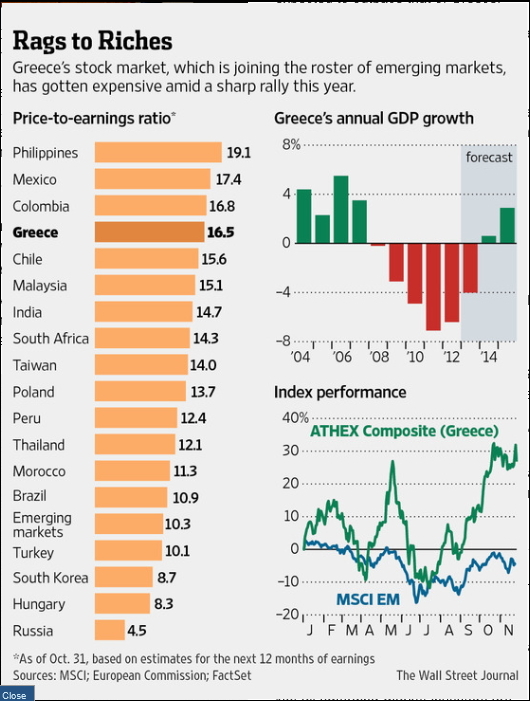
I was reading WSJ and noticed that the Russia has one of the lowest emerging market PEs. Right now it is about 4.5. Greece is a lot higher than I expected...I am guessing because of cyclically low earnings. http://online.wsj.com/news/articles/SB10001424052702304281004579222303336597192

-
Did you ask him how he does it? Practice or technique? I don't think you need much technique to do it. I could easily read 300 pages a day with good comprehension if that is all I am doing and without pushing myself. As far as technique goes I think the best is to just trace along each line but at a speed faster than you can handle and then try to keep up. I can pretty easily read more than a page a minute this way. The key idea is not speed reading but to vary the speed of your reading and the depth of your thinking based on the importance of what you are reading. Some things you should just skip reading. Other things require only a cursory glace. And still other may require you to read them 10 times over and think very carefully about them. The other thing that is covered in the book is that you need to be very active in your reading. You need to ask questions. Think about the structure of the book. the key arguments, facts supporting them etc. The point is not to read every word....its to get the most out of the book in the shortest possible amount of time.
-
I talked to Francis Chou and he said he reads over 300 pages a day.
-
One big thing I got from the Art of Profitability was the whole idea of mental math and applying Fermi problem type solutions to business models. The basic idea is back of the envelope type calculation where you get an order of magnitude estimate but not precise numbers. Its a pretty good exercise to do with any business to estimate how much money they should be making.
-
Buffett wasn't buy and hold until the later part of his career. I think buy and hold makes total sense if you are managing a 100 billion dollar portfolio because at that point it takes a while to accumulate large positions in stocks and its also extremely difficult to outperform. Trading costs also become a huge issue. BTW, I think Buffett was well aware that it was an opportune time to sell KO in the late 1990's. Not all his decisions are based purely on returns.
-
I think he is just wrong. I never understood how the US today parallels the US during 1930's or Japan during 1980's. In both cases banks and businesses were insolvent and consumers were fine. This lead to deflation. In the US today consumers are in debt but businesses and banks are fine. Businesses are especially cash rich. Totally different situation. You can't fire your wife or your children. Consumers just keep consuming. Unless interest rates rise dramatically indebted consumers won't cut back. And interest rates won't rise unless there is significant inflation because this is the only cue for the Fed to raise interest rates. So the only way to get deflation is if the Fed overcompensates for inflation. And significant inflation is also unlikely because consumers can't afford much of it. So you are stuck with noflation.
-
What do you do when the wind doesn't blow and the sun doesn't shine. There is NO good answer that has ever been provided to this elementary question. Wind and solar are both extremely costly, overhyped and erratic sources of power. Nuclear power has always been the only real solution. That was already clear 50 years ago.
-
I walked into a build-a-bear store. This is a store where kids can build their own teddy bears. They can accessorize the bears with little outfits, shoes etc. The bears are cheap...the accessories are pricey. I remember thinking wow what a fantastic idea ... this must be a great business. I checked it out on valueline today. The company is unprofitable. I was really amazed. It appeared to me to be an interesting case study of how a great idea doesn't guarantee a great business. The stores have good gross margins, good inventory turn over but the company has high SG&A. I think it is just a case of over-expansion and bad management. Not sure if anyone knows the story here. I am Canadian so this is the first time I have ever seen a store like this.
-
I think mental models are relatively ubiquitous. The mind in a sense automatically uses them. The real problem is when you use the wrong mental model for a particular situation or fail to apply a mental model due to wrong contextual cues
-
Maybe part of the problem is I don't buy their deflation bet. I don't believe that United States is similar to Japan. Japan, like Depression Era United States, had a problem with businesses being heavily in debt. This is not the same as consumers being in debt. You can't fire your wife. Consumers don't react the same way to huge debts as businesses do. Business engage in fire sales and fire workers. This causes deflation. Consumers on the other hand just keep consuming or slightly reduce consumption. You don't get deflation. The deflation options may be ok but AFAIK they are also completely hedging equities. Or have they altered this policy. I always thought the equity hedge was part of their deflation bet.
-
Implied vols are suspiciously low: http://www.zerohedge.com/news/2013-04-16/not-what-low-volatility-environment-looks Seth Klarman exchanged MSFT stock for MSFT options: http://whalewisdom.com/filer/baupost-group-llc-ma
-
Perhaps but it was an unusual macro bet because it was tied to specific dates and cashflows. For instance Burry knew when the ARMs would reset on subprime borrowers and Paulson picked out mortgages more likely to default. I don't consider this a pure macro speculation. To me a true macro bet is more like FFH's bet on deflation. There are no individual mortgages or companies to bet on. There are no specific date like ARM resets or cashflows to examine. FFH is betting on what will happen to whole economies based on the collective need to pay down debt. To me this is pretty much speculation.
-
Do you think Bitcoin is a safe store of value?
rukawa replied to mikazo's topic in General Discussion
And I hear that Indian brides are demanding bitcoin jewelry for the weddings instead of gold :P Most forms of currency have some form of intrinsic value. Gold can be used for jewelry. Cigarettes can be smoked. Dollar bills can be used to pay taxes to the government. The only way a currency with no intrinsic value can establish itself is through a huge entity like a government or massive corporation providing it with value by accepting it in exchange. -
I don't think there is any way to take advantage of this except by not buying a house in Canada. I strongly doubt there will be a crash. In Canada mortgages have recourse. House owners will simply not sell their houses and attempt to rent them out. The result will be a prolonged period of flat prices in housing....probably for 15 or so years.
-
I have access too. How do you setup your screen?
-
Always the coy one :P
-
Does anybody use CapitalIQ? Anyone have regular screens they run like NCAV? Stocks which have new lows? Large share buybacks? The idea of going through Valueline is appealing to me but I was also thinking with augmenting this with some screens. @West: I thnk the idea of writing down aggressive buy price is a wonderful idea. Thanks.
-
I am trying to develop a set of regular investing habits. I was wondering what habits people on here have. What screens do you regularly screen for? What newspapers, magazine do you regularly read? What do you look at daily, monthly, weekly (Valueline, screens etc).
-
I am interested in investing in stocks in Europe and Asia but I wonder what the best way to do this is. I know that some stocks list as ADR's on US exchanges but liquidity can be low. The other alternative is to convert to a foreign currency and buy stocks on a foreign exchange. I am wondering how these alternatives compare and what other peoples experience has been. I also wonder about the mechanics of buying a foreign stock with an online broker. If you sell the stock does it settle in the currency of the stock...would you need some sort of forex account? I am currently with questrade but I am guessing other brokers would be similar. What is the best way to minimize foreign exchange fees? Also what is the best online broker for this. I was thinking interactive brokers.