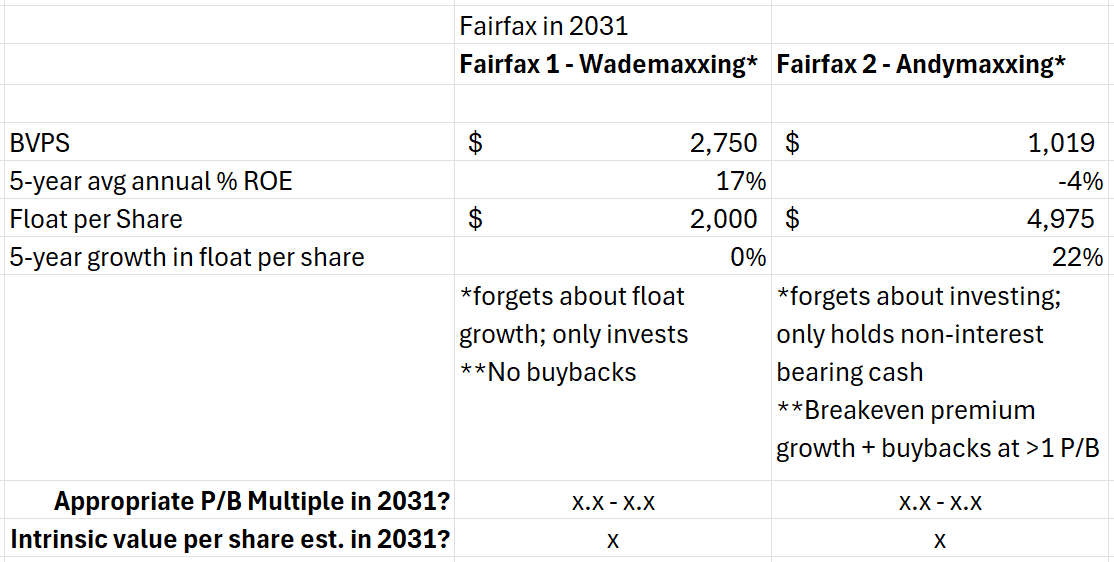
Hi @Viking, enjoyed meeting you in April. On the topic of BVPS at Fairfax:
An asset is a controlled resource that is expected to provide future cash flows. If one assumes that in the long run:
1. Fairfax's float is likely to be greater than or equal to current
2. The insurance businesses are likely to approximately break even
Then Fairfax's float of $41B can be considered an asset that is at least as valuable as cash.
As @Packer16 has pointed out, the current combined cost of debt + float is less than zero. If this can possibly persist, Fairfax in 2026 might be simplified as being seen as a pile of ~$78B in T-Bills, yielding ~$3B per year after tax, buying itself for at a pace of 5+% per year at a valuation of $35B. Viewed from this lens, intrinsic value per share is >$3,500/share and buybacks are occurring in the $1,600s. This valuation seems to be in line with others' conclusions. I believe this is more or less the current situation, and approximately in line with how Prem views it. What do you think? See below for excerpts from the 2025 annual report.
In short, Book Value per Share has become irrelevant as it largely excludes important economics at Fairfax including:
1. Float
2. Excess economic goodwill vs reported goodwill of insurance subsidiaries
3. Excess fair value vs carrying value of non-insurance businesses, and
4. The growing pace of buybacks, and the incorrect effect effect they have on intrinsic value per share growth if success is measured in BVPS
From the 2025 annual report:
Page 27, float as "perhaps" an asset:
Page 22, goodwill accounting rules obscuring insurance subsidiary value:
Page 23, multiple-to-BVPS' irrelevance when approximating intrinsic value:
Page 7, likely after-tax income of ~$3B for the next 4 years: